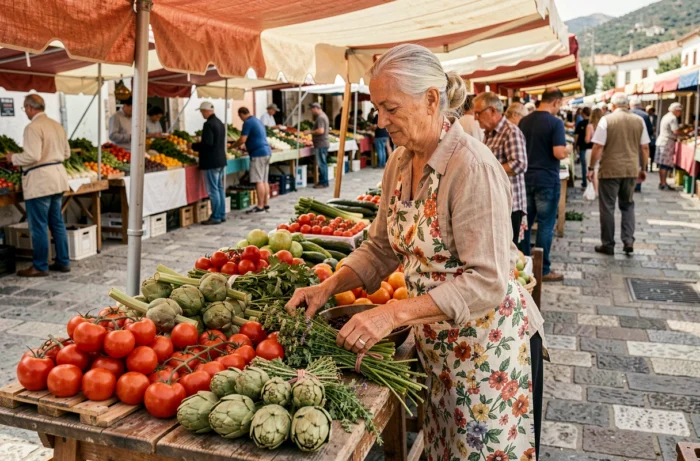
The weekly market in Porto Torres takes place every Monday morning in the city center, near the port. This municipality in the north-west of Sardinia, connected by ferry to several Mediterranean ports, maintains an open-air commercial meeting point where local producers, fishermen, and street vendors converge. The market covers both food (fruits, vegetables, cheeses, Sardinian cold cuts) and textiles, hardware, and crafts.
Porto Torres Fish Market: Direct Sales at the Port
The least documented aspect of the Porto Torres market is its mercato ittico, located on the Banchina della Teleferica, in the port area. Fishermen sell their catch of the day directly, without intermediaries, which sets it apart from the fish stalls found in the covered markets of other Sardinian cities like Cagliari or Olbia.
This fish market operates on a principle of direct sales of local catch. The species offered vary according to the season and weather conditions. In practice, the days and hours of operation can change from week to week: the decision to open depends on the previous day’s fishing trip and the state of the swell.
This variability is a characteristic shared by several port markets in Sardinia. Before heading out, it is advisable to check the updated hours, any potential closing days, and the forecasted weather conditions. Those wishing to explore the weekly market of Porto Torres in Sardinia in its maritime dimension should incorporate this flexibility into their plans.
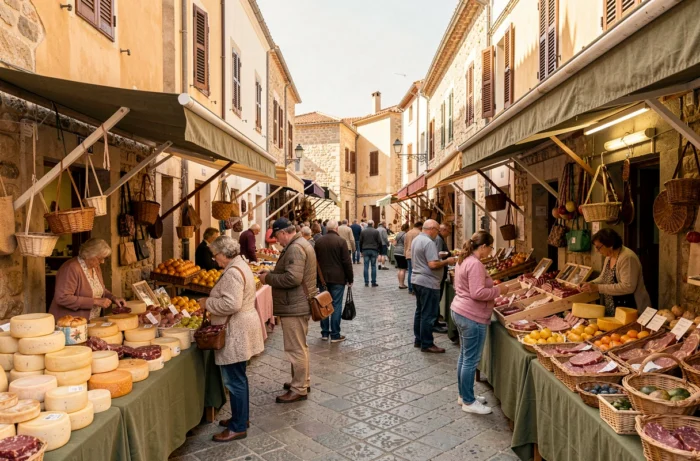
Typical Sardinian Products at the Porto Torres Market
The Monday morning market is primarily a supply point for locals. The food stalls occupy most of the space and reflect the agricultural sectors of the north-west of the island.
Sardinian Cheeses and Cold Cuts
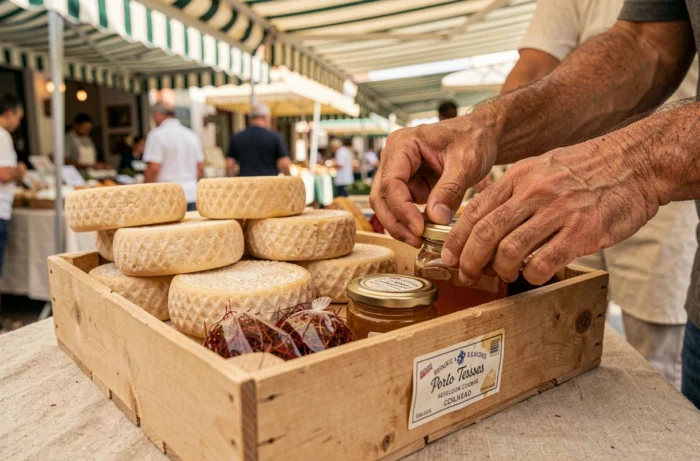
Sheep cheeses at different aging stages are the flagship product. Pecorino sardo, in its fresh (dolce) and aged (maturo) forms, is ubiquitous. Fresh ricottas and stretched curd cheeses can also be found.
In terms of cold cuts, producers offer salsiccia sarda (a dry sausage flavored with wild fennel) and, depending on the stalls, guanciale or pancetta from local pig farms.
Fruits, Vegetables, and Olive Oil
Farmers from Nurra (the agricultural plain surrounding Porto Torres) sell tomatoes, zucchini, eggplants, and artichokes according to the seasonal calendar. Extra virgin olive oil produced in the province of Sassari is offered in cans or bottles, often by the producer themselves.
- Pecorino sardo dolce and maturo, fresh ricotta: sheep cheeses are the most representative products at the stalls
- Salsiccia sarda with wild fennel, guanciale: artisanal cold cuts from pigs raised in the north-west
- Artichokes, tomatoes, and eggplants from the Nurra plain: local vegetable production sold through short supply chains
- Extra virgin olive oil from the province of Sassari: packaged by local olive growers
Porto Torres as a Starting Point for Markets in North-West Sardinia
Porto Torres is not the only town in the area to hold a weekly market. The north-west of Sardinia has a calendar of markets spread throughout the week, allowing for multiple visits during a stay.
Each day of the week corresponds to a different municipality. Sassari, the provincial capital located about twenty minutes by car, hosts a larger and more diverse market. Alghero, on the west coast, offers a permanent covered market and an open-air market. Stintino, Sorso, and Castelsardo complete the network.
What distinguishes Porto Torres is its position as a port of arrival for ferries from Genoa, Barcelona, and Marseille. Travelers arriving on Monday morning often find themselves directly at the market, making it a common first contact with the island’s daily life.
Regulations on Street Trading in Sardinia: What It Means for Visitors
Trade in public areas in Italy is governed by municipal regulations. Porto Torres, like all Sardinian municipalities, grants concessioni di posteggio (stall concessions) to street vendors. This system ensures that the stalls present each week are identified and authorized by the town hall.
For visitors, this regulation has a concrete consequence: the composition of the market is relatively stable from week to week. Local producers with a concession return to the same location, making it easier to spot and build loyalty. Occasional vendors (spuntisti) can occupy vacant spots, but they remain in the minority.
The municipal deliberations published by the municipality of Porto Torres on its albo pretorio (official online bulletin board) theoretically allow for updates regarding market organization, exceptional relocations, or suspensions.
The Porto Torres market remains an event rooted in the weekly rhythm of this port city. Its uniqueness lies in the coexistence of a general market in the city center and a fish market subject to the whims of fishing. For a trip to Sardinia that starts in the north-west, Monday morning in Porto Torres offers a direct entry into Sardinian daily food life, far from the marked tourist circuits of Olbia or the Costa Smeralda.