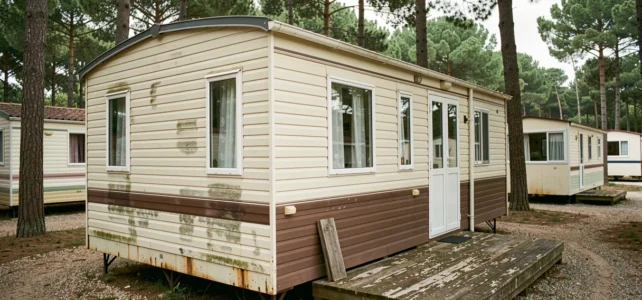
A mobile home is legally a recreational vehicle residence (RVR). This qualification is based on three cumulative criteria: temporary or seasonal occupancy for recreational use, the maintenance of mobility means (wheels and towing bar), and the prohibition of circulation on public roads.
When a mobile home exceeds twenty years, none of these criteria change. The confusion between age and legal replacement obligation persists, fueled by certain commercial practices in camping.
Legal reclassification of the old mobile home: the real legal risk
The main danger for an aging mobile home owner does not come from its age, but from its state of immobilization. As soon as a mobile home loses its means of movement or becomes permanently fixed to the ground (permanent connections, removal of wheels, construction of an adjoining masonry terrace), it can shift from the regime of recreational vehicle residence to that of construction subject to the Urban Planning Code.
This reclassification radically changes the necessary authorizations. An RVR installed in a camping site or a residential leisure park (RLP) does not require a building permit or prior declaration. A construction, on the other hand, falls under common urban planning law: permits, compliance with the local urban planning plan, or even demolition if the land does not allow for this designation.
To understand the regulations for mobile homes over 20 years old in its concrete implications, it is essential to keep this point in mind: it is the actual mobility of the mobile home that protects its legal status, not its manufacturing date.
On private land, the situation becomes even more complicated. The installation of a mobile home outside of camping or RLP is highly regulated. If the old mobile home has lost all towing capacity, the landowner is exposed to a report of violation of the Urban Planning Code.

Depreciation clause in the camping plot contract
No French law imposes an age limit for a mobile home installed in a camping site. The Tourism Code does not mention any obsolescence threshold related to age. The only source of obligation on this point is the lease contract signed between the mobile home owner and the camping manager.
Some contracts contain a so-called “depreciation” clause that sets a maximum duration for the mobile home’s presence on the plot, often around twenty years. This clause, if clearly written and accepted by both parties, is generally enforceable.
The abusive nature of such a clause can, however, be contested. A court may find it abusive if it creates a significant imbalance between the rights of the manager and those of the owner. Here are the elements that weigh in the evaluation:
- The actual condition of the mobile home at the time replacement is required: a well-maintained mobile home over twenty years old, meeting safety standards, does not present the same profile as a degraded model
- The proportionality of the constraint: forcing an owner to purchase a new model (an investment of several tens of thousands of euros) solely based on age can be deemed disproportionate
- The transparency of information at the time of signing: if the clause was not clearly brought to the signer’s attention, its validity is weakened
What to do in the face of a replacement request
Reading the entire contract is the first step, looking for any mention of maximum duration, obsolescence, or the condition of the mobile home. If no clause appears in the signed document, the manager has no contractual basis to impose replacement.
If a clause exists, having the condition of the mobile home assessed by a bailiff or an independent expert constitutes a negotiation lever. An old but functional and well-maintained mobile home weakens the justification for a replacement based solely on age.
Taxation and VAT: the pitfalls of the old mobile home in LMNP
Articles aimed at the general public about mobile homes over twenty years often overlook the tax angle. When a mobile home has been acquired as part of a non-professional furnished rental (LMNP) or para-hotel activity with VAT recovery, a regularization over twenty years may apply in the event of resale or cessation of activity before this term.
Specifically, if the owner sells their mobile home or stops renting after fifteen years, they will have to repay a portion of the VAT initially recovered, proportional to the remaining years. This mechanism makes the twenty-year mark relevant not for reasons of obsolescence, but for tax reasons.
Beyond twenty years, regularization no longer applies. Reselling or ceasing activity after this threshold does not result in any VAT repayment. For owners in LMNP, keeping the mobile home until the end of the regularization cycle is often the most profitable strategy.
Resale and evolution of the second-hand market in camping
Reselling a mobile home over twenty years old remains legally possible. The mobile home is a movable property, its sale falls under the Civil Code just like a vehicle or a caravan. No national prohibition targets the transfer of an old model.
The main hindrance comes from the internal regulations of camping sites. Some managers refuse to allow an old second-hand mobile home to be reinstalled on a plot, which effectively limits the market. The potential buyer must obtain the camping’s agreement before any transaction, or risk becoming the owner of a property without a location.
A discussed evolution in the Senate in 2026 could tighten these conditions: mobile homes over nine years old could no longer be resold within the camping starting December 2026. If this measure comes into effect, it would profoundly transform the second-hand market and accelerate the depreciation of old models.
Seasonal rental and new obligations
Owners who rent their mobile home seasonally must also monitor the increasing regulation of tourist rentals. A registration number may now be required for seasonal rental, gradually aligning the obligations of mobile homes with those of traditional short-term rentals.
The regulatory framework for old mobile homes thus plays out on three distinct fronts: maintaining mobility to preserve RVR status, the plot contract to remain in camping, and taxation to avoid VAT regularizations. An owner who masters these three dimensions retains control, regardless of the age indicated on the identification plate of their mobile home.