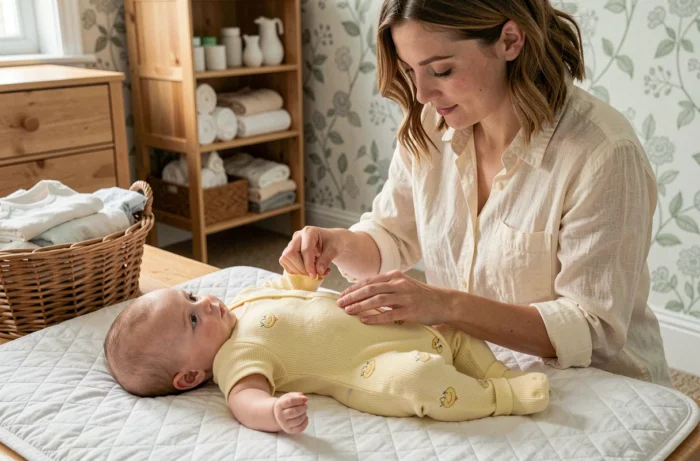
A body that is too big and gapes at the collar, a pilot suit bought in advance but never worn because the season changed too quickly: we have all made these mistakes when building a baby’s wardrobe. Dressing an infant in style is not about piling on cute pieces; it’s about choosing a few well-cut garments made from materials that can withstand frequent changes and washes.
Fabrics and certifications: what touches baby’s skin matters more than color
Before looking at prints or cuts, check the label. An infant’s skin is significantly thinner than an adult’s, and the risks of irritation or allergic reactions are real with poorly controlled textiles.
Organic cotton remains the safe bet for bodies and pajamas worn directly against the skin. Its untreated fiber limits exposure to chemical residues. To go further, the Oeko-Tex Standard 100 certification ensures that the fabric has been tested for harmful substances (formaldehyde, azo dyes, heavy metals). An Oeko-Tex class I certified garment is suitable for babies; this is the strictest level of control in this standard.
The European regulation on the general safety of products (RGSP) has recently strengthened traceability requirements: product identifier, contact details of the manufacturer or importer, systematic reference to REACH standards. In practice, labels are becoming more detailed, which is a good sign. If a garment sold online does not display a lot number or European responsible party, we move on.
You can see the baby category on Les Bébés Fringueurs to find pieces that combine style and textile requirements without having to analyze each product sheet for hours.
Gender-neutral baby clothes: a practical as well as aesthetic choice
The “girl” and “boy” sections no longer hold the monopoly. Unisex collections are gaining ground among manufacturers, who are now creating dedicated sections in their ranges. This is not just a stance: it is a growth lever identified by market studies in the children’s segment.
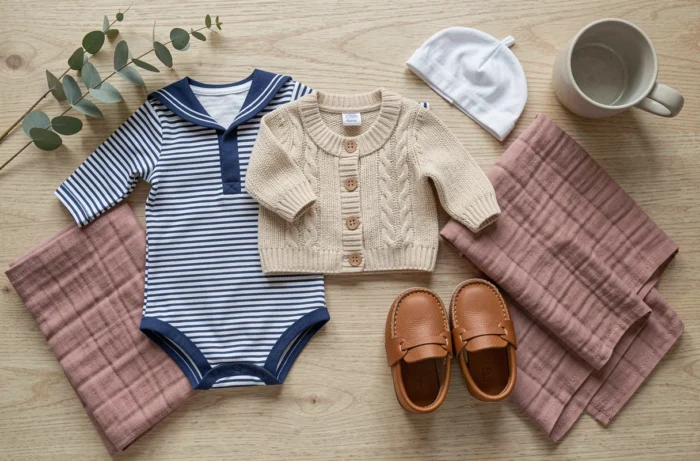
From a practical standpoint, a gender-neutral wardrobe is more easily passed from one child to another. A sage green jumpsuit or an ecru set will serve just as well for a first baby as for the next, regardless of gender. This reduces purchases, simplifies storage, and keeps the style consistent.
Neutral palettes (beige, terracotta, khaki, faded blue) mix effortlessly. The result: fewer pieces in the drawer, but looks that work with every combination. This is the foundation of a baby wardrobe designed to last several months.
Baby clothing sizes: buy just right instead of buying large
The classic reflex is to take one size up so that the baby “grows into it.” On paper, it’s clever. In practice, a pajama that is too long hinders movement, and a body that floats allows air to pass at the belly.
We buy the size that corresponds to the baby’s current weight, not their theoretical age. The indications “3 months” or “6 months” on labels are averages. A baby born at four kilos will not wear “newborn” for more than a week. Returns vary on this point depending on the brands, and the same “3 months” can fit differently from one manufacturer to another.
For outerwear (coats, pilot suits), a half-size margin is justified because they are layered. For bodies, pajamas, and socks, the right size remains the rule.
Essential pieces to have in multiple copies
- Long-sleeve cotton bodies: between five and seven are enough to rotate with the washes, favoring crossover openings for the first weeks
- Pajamas with integrated feet: three to four pieces cover the week, and snap buttons along the length make nighttime changes easier
- Socks or soft booties: baby’s feet do not regulate temperature well, two to three clean pairs in rotation avoid unpleasant surprises
Dressing baby according to temperature: the layering method
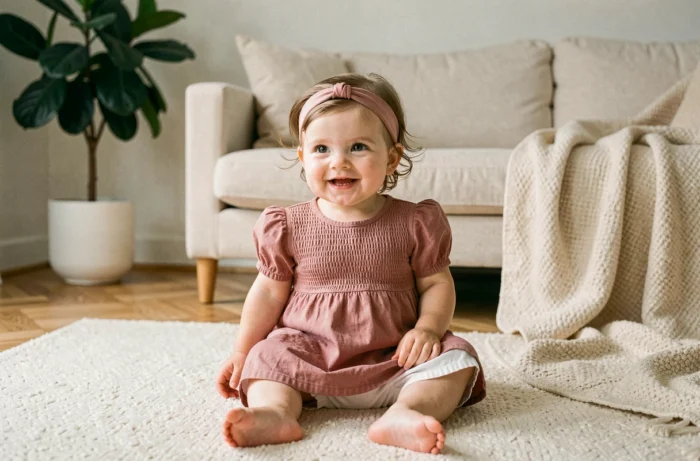
The often-cited rule is “one layer more than yourself.” It works, provided it is applied sensibly. In winter, we layer a body, pants, sweater, and suit. In summer, a body alone with a hat is often enough.
The neck test remains the best indicator: if the baby’s neck is warm and dry, the outfit is appropriate. If it is damp, we remove a layer. Cold hands are not a reliable signal; infants’ extremities remain cool even when the body is at a good temperature.
Natural materials help regulate: cotton wicks moisture away in summer, merino wool (fine, non-itchy) insulates without overheating in winter. We avoid synthetic fabrics in direct contact with the skin, especially for sleeping.
Cold weather outing checklist
- A long-sleeve cotton body as the first layer, fitted to the body
- A soft pair of pants and a sweater or knitted cardigan, easy to remove in a heated store
- A pilot suit or sleeping bag for the stroller, with a hat and mittens if the temperature drops significantly
- A spare blanket in the diaper bag, more versatile than an extra layer of clothing
Style and practicality: the details that change daily life
A stylish baby garment is useless if changing takes five minutes. Closures to avoid: round buttons on the back (inaccessible when baby wriggles) and too-narrow collars that force the head through.
American necklines (crossed at the shoulders) and snaps along the crotch are the two cutting details that make a garment truly functional. They can be found on well-designed pieces, and they are what make the difference between a purchase that is used daily and one that stays in the drawer.
Style also comes from color consistency. Three or four basic shades in the wardrobe allow for effortlessly coordinated outfits. We don’t need ten different prints to dress baby stylishly; we need pieces that work together.