Dressing a baby in style involves making choices between materials, cuts, and finishes, each of which has a varying impact on comfort and safety. This article measures the concrete differences between the options available to young parents, from fabric selection to new fashion collaborations that are redefining toddlers’ wardrobes.
Baby textiles: organic cotton, bamboo, and linen face off
The choice of material determines thermal comfort, skin tolerance, and garment durability. Here is a comparison of the three most commonly used natural fibers for newborn clothing.
| Criterion | Organic Cotton | Bamboo | Linen |
|---|---|---|---|
| Softness to the touch | High | Very high | Medium (softens with washing) |
| Breathability | Good | Very good | Excellent |
| Resistance to frequent washing | Very good | Medium | Very good |
| Drying | Fast | Fast | Slow |
| Risk of irritation on sensitive skin | Low | Very low | Low to moderate (new rough fibers) |
| Availability in baby fashion | Wide | Growing | Limited |
Organic cotton remains the default versatile choice for bodysuits and pajamas. Bamboo has the advantage in softness, making it suitable for babies prone to eczema. Linen, despite its superior breathability in summer, requires several washes before it becomes comfortable against a baby’s skin.
To explore pieces that combine these materials with suitable cuts, les bébés fringueurs for babies offers a selection categorized by age and season.
Composition labels and certifications: what parents check in 2026
The issue of chemical substances in baby textiles has taken on new significance. Water-repellent or stain-resistant treatments applied to certain garments sometimes contain PFAS, compounds whose presence in children’s items is receiving increasing media attention.
This vigilance is prompting more and more parents to read composition labels before any purchase. Two reflexes are becoming widespread: checking for recognized certifications that guarantee the absence of harmful substances, and avoiding garments that mention chemical surface treatments without specifics.
A stylish garment for a baby does not need a stain-resistant treatment. A certified cotton bodysuit without chemical additives protects the skin and can be washed at high temperatures without losing its properties. In contrast, a textile treated to resist stains often loses breathability, which goes against the thermal comfort sought for an infant.
Reading a baby textile label: key points to check
- Fiber composition: prioritize natural materials making up more than half of the fabric, with the remainder possibly being elastane for flexibility in the cut.
- Mention of surface treatments: any water-repellent, stain-resistant, or flame-retardant treatment warrants research into the nature of the product used.
- Presence of a recognized textile label: these certifications regulate the levels of substances allowed in contact with infants’ skin.
- Washing instructions: a baby garment that cannot withstand high-temperature washing raises questions about the durability of its dyes and finishes.
Eco-responsible fashion capsules: when baby style meets adult codes
The collaboration between Veja and the Danish label Konges Sløjd for the autumn-winter 2026-2027 collection illustrates a shift in children’s fashion. Models of sneakers specifically designed for babies feature the colors and prints of adult collections, with soles adapted for developing feet.
Baby capsules resulting from eco-responsible collaborations are no longer a niche. They establish an ecological storytelling from early childhood, with traceable materials and limited series that create a stylish effect without sacrificing comfort.
This phenomenon is changing how parents put together an outfit. Instead of looking for a “cute” garment, they assemble pieces whose origin, material, and design tell a story. A neutral organic cotton bodysuit paired with a pair of Veja x Konges Sløjd sneakers creates a cohesive look, rooted in the same codes as adult fashion.

Cuts and closures: the criterion parents underestimate
A garment can be made of certified organic cotton, signed by an eco-responsible brand, and still be difficult to put on. The cut and closure system determine the actual usability of a baby garment.
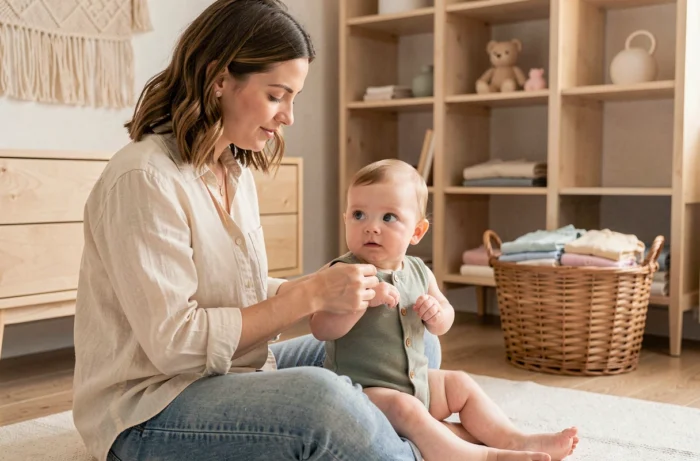
Bodysuits with side snaps can be put on without going over the head, reducing dressing stress for both the infant and the parent. Pants with elastic waistbands accommodate growth without abdominal compression. In contrast, traditional buttons and narrow collars, even on aesthetically pleasing pieces, often end up at the back of the drawer after two uses.
Adapting the outfit to the temperature without piling on layers
The classic reflex is to layer clothing. This approach complicates dressing and can lead to overheating. A more effective alternative relies on choosing a main garment suitable for the ambient temperature.
- In cool weather: a corduroy pajama over a long-sleeved bodysuit is sufficient in most heated interiors.
- In summer: a short-sleeved cotton bodysuit worn alone offers better thermal regulation than a lightweight two-piece set.
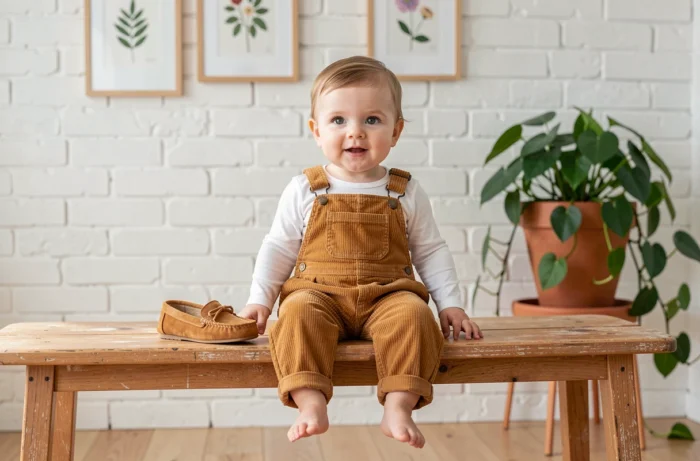
- For outings: a front-closure overall allows for quick adjustments without completely undressing the baby.
A well-cut garment in a breathable material replaces two layered pieces. This principle simplifies the wardrobe, reduces the number of items to purchase, and makes each change easier.
A baby’s style is built on verified material choices, cuts designed for daily use, and, for parents who wish, pieces from traceable collaborations. The most significant factor remains the textile composition: a garment made of certified cotton without chemical surface treatment simultaneously covers comfort, skin safety, and wash durability.