The distinction between teleassistance and medical telemonitoring is crucial for setting up a home monitoring system. The former pertains to home care with an alert system activated by the senior or automatic sensors. The latter is a prescribed telemedicine act, reimbursed by Health Insurance, reserved for pathologies monitored by healthcare professionals. Confusing the two skews the calculation of out-of-pocket expenses and exposes families to unsuitable offers.
Teleassistance and medical telemonitoring: a costly confusion
We regularly observe families subscribing to a teleassistance service thinking they will benefit from remote medical monitoring. The regulatory framework is clear: medical telemonitoring involves a connected medical device, a prescription, and reimbursement by Health Insurance. Teleassistance, on the other hand, relies on a non-medical alert system funded by the user, possibly with assistance such as APA.
This confusion is perpetuated by telemarketing, a historically aggressive prospecting channel in the sector. Since August 11, 2026, prior consent has become the rule for telemarketing, which should limit unsolicited calls. Families looking for monitoring services for my parents should verify that the provider clearly distinguishes these two areas in its offer.
A tax point often misunderstood: the “personal services” tax credit applies to teleassistance services, not to equipment. The purchase of the device, bracelet, or pendant does not fall within the scope of the tax credit. Only the monitoring and intervention service is eligible.
Fall sensors and passive detection: real reliability of home devices
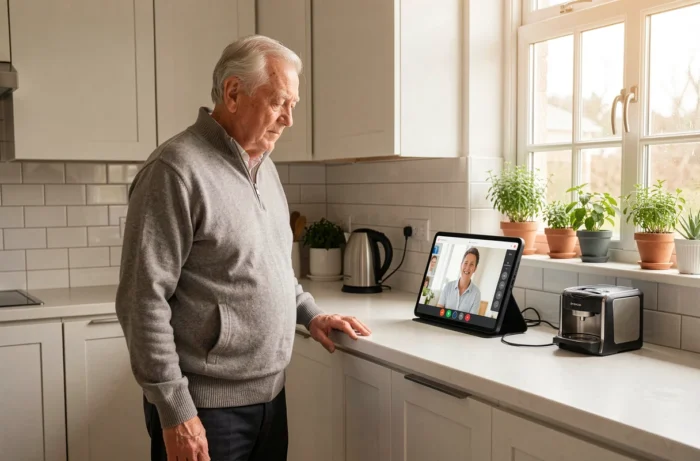
The alert button worn on the wrist or around the neck remains the foundation of teleassistance. Its main flaw is well-known: it assumes that the elderly person is able to activate it. In the event of a fall with loss of consciousness, the device is useless.
Automatic fall detection sensors compensate for this limitation. They work via an accelerometer integrated into a bracelet or watch, triggering an alert without the wearer’s intervention. We recommend checking three parameters before choosing a device:
- The false positive rate, meaning alerts triggered by a sudden movement or a falling object. A high rate may lead the senior to disable the system
- The network coverage of the device (GSM, Wi-Fi, or both), which determines if the alert works in all rooms, including the bathroom and garden
- The battery life and charging method, as a discharged bracelet at night is an useless bracelet
Passive devices (floor motion sensors, door opening detectors, lifestyle habit analysis by algorithm) represent a complementary layer. They require no action from the senior and detect deviations from a routine: prolonged absence of movement, non-opening of the refrigerator, light left on continuously at night.
Home video surveillance: legal framework and practical limits
Installing a camera in an elderly parent’s home raises a question of consent. Home video surveillance is legal as long as the person filmed explicitly consents and the images are not accessible to unauthorized third parties. For a parent with cognitive disorders, the question of informed consent becomes legally delicate.
In practice, video surveillance often generates rejection from the senior who perceives it as intrusive. Passive sensors without images offer an acceptable compromise between security and respect for privacy.
Reform of Home Autonomy Services and impact on senior monitoring
The home care sector is reorganizing around Home Autonomy Services (SAD), a framework established since 2024-2025. This reform merges the former home help and support services (SAAD) and home nursing services (SSIAD) into a single structure.
For families, this reform changes the game on one specific point: SAD becomes the single point of contact to coordinate housekeeping, care, and security devices. Teleassistance can be integrated into the personalized aid plan rather than subscribed to separately, simplifying administrative management and potentially altering funding through APA.
Choosing a teleassistance provider in this new framework
The “personal services” approval remains the condition for the service to qualify for the tax credit. We recommend verifying that the provider has this approval and is registered with the department, which guarantees minimal quality control.
The selection criteria that make a difference on a daily basis:
- The response time after the alert is triggered, and the procedure applied at night when no relative can be reached
- The possibility of combining teleassistance with regular home visits, a service offered by some postal and associative operators
- Transparency regarding the exact scope of the tax credit (service only, not equipment)
- Interoperability with the local SAD to avoid service duplication
Securing the night: the weak link in home monitoring
The majority of falls among seniors occur at night, during trips to the bathroom. A classic teleassistance device does not cover this risk if the bracelet is left on the nightstand.
An automatic lighted path between the bed and the bathroom significantly reduces the risk of nighttime falls. This type of arrangement, combined with grab bars and non-slip flooring, falls under home adaptation and can be funded by MaPrimeAdapt’ or APA.
Bed sensors that detect getting up and activate floor lighting represent the junction between adaptation and monitoring device. They transmit information to the alert system without the senior needing to wear anything during sleep.
The most sophisticated monitoring device does not replace an adapted home. Safety at home relies on the interplay between physical adaptation, passive sensors, and the alert platform, all coordinated with the local SAD of the department.