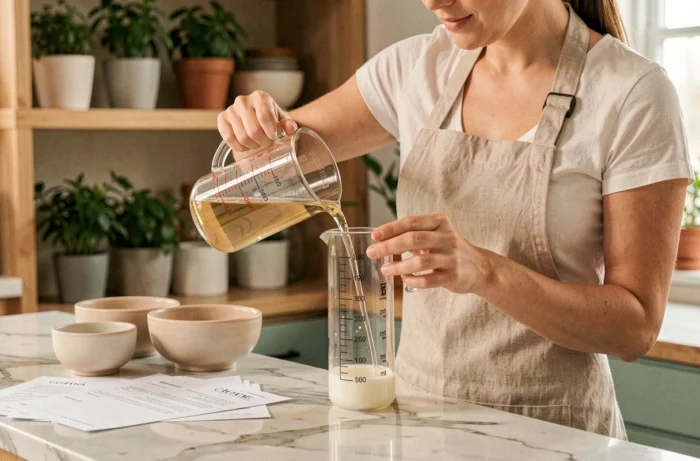
We often encounter the problem when pouring: the recipe calls for 25 cl of milk, but the measuring cup only displays milliliters. Or the reverse. Before doubting and risking a batter that is too liquid, it’s better to settle the question once and for all. Converting 250 ml to centiliters involves a single operation, and the real difficulty is not the calculation, but reading the measuring cup.
Measuring cup without centiliter markings: how to manage
Most measuring cups sold in France display milliliters on one side and sometimes centiliters on the other. When only the milliliter scale is present, simply locate the 250 ml line: 250 ml is exactly equal to 25 cl.
The problem becomes more complicated when the measuring cup jumps from 200 ml to 300 ml without intermediate markings. In this case, we have three concrete options to aim for 250 ml without improvising.
- Fill to 200 ml, then add 50 ml measured in a small container (a standard mustard glass holds about 200 ml, a syrup measuring cap is around 20 to 30 ml depending on the brand)
- Use a kitchen scale: place the empty container, tare it, then pour water or milk until reaching 250 g, since for these liquids, the volume in milliliters and the mass in grams are nearly identical
- Obtain a graduated food syringe for small quantities and break the measurement into several parts
To convert 250 ml to cl without error, remember the simple rule: divide the number of milliliters by 10. This operation works for all values, not just 250.
Conversion ml to cl: the rule and its limits in cooking
The formula can be summarized in one line: cl = ml ÷ 10. No need for a table for common values once this reflex is acquired. 100 ml gives 10 cl, 150 ml gives 15 cl, 250 ml gives 25 cl, 500 ml gives 50 cl.
The frequent error does not come from the calculation. It comes from reading the level in the container. A clear liquid (water, white vinegar) forms a meniscus, a slight curvature at the surface, against the wall of the glass. We read the bottom of the meniscus, not the top of the curve. For this, the container must be placed on a flat surface and our eyes aligned with the height of the liquid.
Reading the measuring cup while holding it at arm’s length or looking over it skews the measurement by a few milliliters. On 250 ml, the difference remains marginal. On 20 ml of liquid vanilla in a custard, the difference is noticeable.
Volume and mass are not interchangeable
The conversion of 250 ml = 25 cl remains valid regardless of the ingredient because we are talking about volume. However, 250 ml of flour does not weigh 250 g. The mass depends on the density of the product and, for powders, on their compaction in the container.
Some measuring cups display scales in grams for flour, sugar, or rice. These graduations correspond to specific densities: the “flour” line should not be used to measure oil, which is denser. Therefore, we stick to the milliliter scale whenever we need a volume, and reserve the scale for masses.
Measuring 25 cl without a measuring cup: alternative utensils
Sometimes we cook without a measuring cup, at friends’ houses, in vacation rentals, or simply because the measuring cup has disappeared from the drawer. Several everyday references allow us to approximate 250 ml.
A standard water glass generally holds around 200 to 250 ml depending on its size. A medium bowl often holds around 300 ml when filled to the brim. These references are approximate, but they are sufficient for a soup or a cake that tolerates a few centiliters of variation.
For sensitive preparations (choux pastry, pastry cream, hollandaise sauce), a kitchen scale offers more precision than a measuring cup. We weigh the liquid in grams, knowing that for water and whole milk, 250 g is equivalent to 250 ml. For oil, the correspondence differs slightly.
When to break down the measurement
For small volumes (liquid spices, extracts, colorings), large measuring cups graduated in increments of 50 or 100 ml are not sufficient. A small measuring cup or a graduated food syringe prevents estimating a spoonful by eye.
Breaking down also works in reverse. If the recipe calls for 75 cl and the measuring cup does not exceed 500 ml, we measure 500 ml (50 cl) then 250 ml (25 cl). Adding two reliable measurements remains more precise than filling a bowl “approximately.”

Quick conversion table ml, cl, and liters
For the values we encounter most often in French recipes, this table avoids pulling out the calculator.
| Milliliters (ml) | Centiliters (cl) | Liters (l) |
|---|---|---|
| 50 ml | 5 cl | 0.05 l |
| 100 ml | 10 cl | 0.1 l |
| 150 ml | 15 cl | 0.15 l |
| 200 ml | 20 cl | 0.2 l |
| 250 ml | 25 cl | 0.25 l |
| 500 ml | 50 cl | 0.5 l |
| 750 ml | 75 cl | 0.75 l |
| 1,000 ml | 100 cl | 1 l |
We always divide by 10 to convert from ml to cl, and by 100 to convert from ml to liters. In the other direction, we multiply. The rule never changes, regardless of the liquid ingredient.
The conversion between milliliters and centiliters is purely mathematical: it depends neither on temperature, nor on the nature of the liquid, nor on altitude. What varies is the precision of the utensil used for measuring. A well-marked measuring cup, reading at eye level, and a stable work surface resolve most dosage errors in cooking.