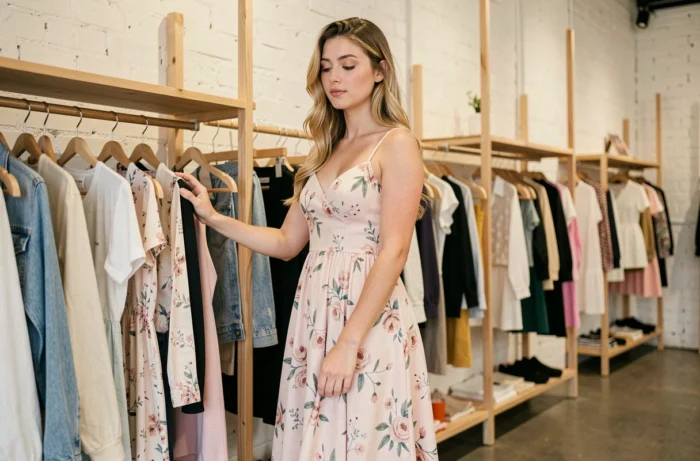
FB Sister is a brand distributed exclusively in New Yorker stores. It does not operate as an independent brand, but as a specialized line within a network that includes several dozen boutiques in France.
This particularity influences its pricing, rapid turnover, and geographical accessibility. Understanding what attracts a young audience to FB Sister requires examining its collection mechanics, pricing strategy, and the stylistic logic that structures its pieces season after season.
FB Sister in the New Yorker portfolio: positioning among other lines
New Yorker distributes several internal brands, each targeting a specific segment. FB Sister coexists with FSBN, SMOG, AMISU, and CENSORED. The table below summarizes their distribution.
| Internal Brand | Target Segment | Stylistic Universe |
|---|---|---|
| FB Sister | Women, young positioning | Y2K, streetwear, preppy |
| AMISU | Women | Basics, classic cuts |
| FSBN | Men | Streetwear, casual |
| SMOG | Men | Urban, sportswear |
| CENSORED | Unisex | Graphic, pop references |
FB Sister occupies the most marked niche in terms of feminine trends. While AMISU offers versatile pieces, FB Sister focuses on Y2K and streetwear codes in a collection renewed each season. This specialization within the same store allows customers to directly compare the lines and mix the universes.
To better understand the reasons for FB Sister’s success, one must also consider the network effect: the brand benefits from the foot traffic generated by all the New Yorker lines, without having to finance its own distribution.
FB Sister Autumn Collection: Pieces Designed to Be Combined
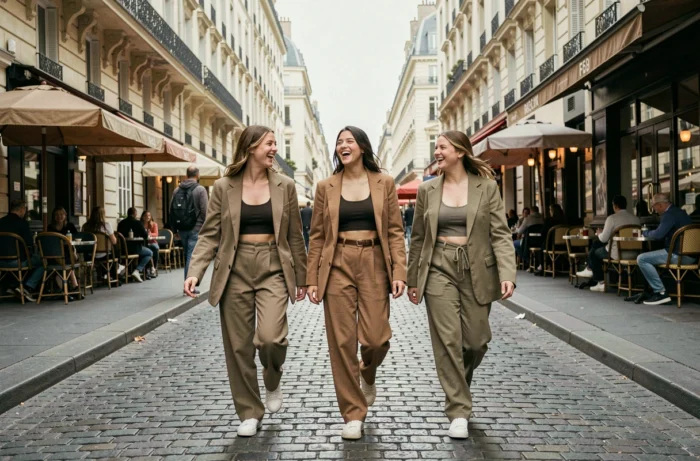
The autumn 2026 collection illustrates a logic that goes beyond a simple trendy item. FB Sister offers matching sets designed to work together or separately. Mini skirts, wide-leg pants, cropped tops, and hoodies form a modular wardrobe system.
This approach reduces purchasing friction. A customer does not need to search for a top that matches a bottom bought elsewhere. The pieces are coordinated by color and material from the design stage, simplifying the composition of a complete outfit in-store.
Color Palette and Materials of the Season
The autumn palette ranges from cream, gray, and brown to navy, including berry tones, camouflage, and soft pastels. This broad spectrum allows for appealing to various stylistic profiles without multiplying references.
- Neutral tones (cream, gray, brown) serve as a base for everyday pieces, easily re-associable from one season to the next
- More assertive colors (berry, camouflage) create visual focal points on strong pieces like bombers or varsity jackets
- Soft pastels add a feminine touch that contrasts with sportswear cuts, a typical mix of Y2K aesthetics
On the outerwear side, faux fur jackets, bombers, and cropped jackets play with volume. The mix of cozy materials and sporty cuts creates a contrast that has characterized the brand for several seasons.
FB Sister’s Stylistic Codes: Y2K, Preppy, and Streetwear at the Same Time
The collection does not choose between Y2K, preppy, and streetwear. It layers them. Blazers and polo collars coexist with sweatpants and oversized hoodies. This mix of styles responds to an observable practice among young audiences: the rejection of a single, fixed style in favor of a personal assembly.
Preppy influences (structured blazers, shirts, pleated mini skirts) provide a framework. Streetwear elements (hoodies, joggers, sporty embroidery) destabilize it. It is this tension between the formal and the casual that produces FB Sister’s visual identity.
Difference with Competing Fast Fashion Brands
Many accessible brands offer Y2K or streetwear. FB Sister’s uniqueness lies in two factors.
The first is the internal coherence of each collection. Prints, embroidery, and sporty details are developed across several types of pieces simultaneously, creating a recognizable universe in-store and on social media.
The second is the pricing strategy, backed by the physical New Yorker network. The absence of its own online distribution concentrates the in-store experience, where impulse buying is facilitated by low prices and rapid turnover of references.

FB Sister and Second-Hand: A Parallel Circuit that Expands the Base
Resale platforms offer second-hand FB Sister pieces. This secondary market signals two things. First, the volumes sold new are sufficient to sustain a second-hand stock. Second, the demand persists beyond the first purchase, confirming that the pieces retain appeal after their release season.
For a customer on a limited budget, second-hand offers access to FB Sister pieces at even lower prices. This parallel circuit does not necessarily cannibalize in-store sales: it exposes the brand to an audience that does not frequent New Yorker or does not have one nearby.
- The most sought-after second-hand pieces are often jackets (bombers, faux fur) and matching sets, categories with higher perceived value
- Basics (tops, t-shirts) circulate less on the secondary market, suggesting they are worn until worn out
- Presence on resale sites acts as an additional showcase, with no marketing cost for the brand
FB Sister’s attractiveness stems from a simple mechanism: a trendy, coordinated, and accessible offer, distributed in a dense physical network. The brand does not distinguish itself through ethical positioning or sophisticated digital communication, but through its ability to offer a complete and coherent wardrobe each season, in which each piece works with the others. It is this system logic, more than the originality of an isolated item, that explains the loyalty of its clientele.