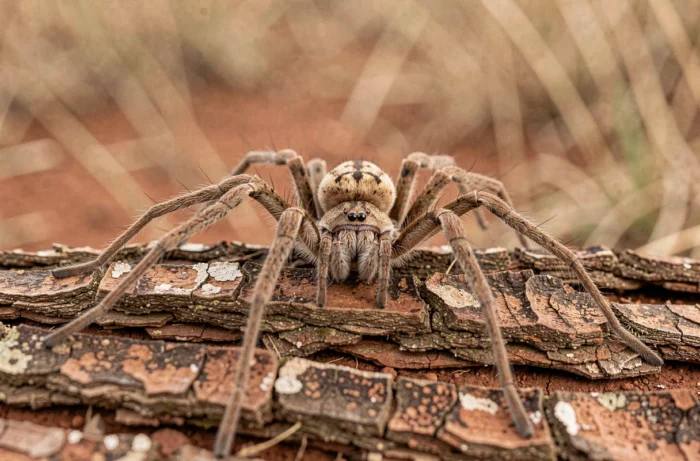
The knife spider is one of the lesser-known arachnids on the African continent. Neither truly a spider nor a scorpion, this animal belongs to the order Solifugae, a group that includes over a thousand species found in the warm regions of the globe. Understanding its lifestyle requires moving beyond the legends circulating online and examining what its morphology, habitat, and behavior reveal about its adaptation to African environments.
Solifuge, knife spider, camel spider: taxonomy and frequent confusion
The term “knife spider” commonly refers to solifuges, but sometimes also to Heteropoda venatoria, a large hunting spider from the Sparassidae family. These two animals have almost nothing in common taxonomically.
| Criterion | Solifuge (order Solifugae) | Heteropoda venatoria (Sparassidae) |
|---|---|---|
| Class | Arachnida | Arachnida |
| Order | Solifugae | Araneae |
| Geographical origin | Arid and semi-arid zones, Old World and Americas | Tropical Asia, introduced pantropical species |
| Silk production | No (no spinnerets) | Yes |
| Venom | None | Weakly venomous, not dangerous to humans |
| Hunting method | Active predation, fast running | Ambush hunting, no web |
This table highlights a fundamental difference: solifuges do not produce silk or venom. Their chelicerae, often compared to blades (hence the nickname “knife”), are used to mechanically grind their prey. Confusing them with Heteropoda venatoria, sometimes seen in African homes, misleads identification and fuels fears.
Anyone interested in the knife spider in Africa benefits from distinguishing these two groups from the outset, as their biology and danger levels differ radically.
Solifuge habitat in Africa: beyond just the desert
The majority of online content associates the solifuge with major deserts like the Sahara or the Namib. This view is reductive. Solifuges also inhabit dry savannas, Sahelian steppes, and semi-arid areas of Southern Africa.
Their Latin name, Solifugae (“those who flee the sun”), reflects their nocturnal behavior. They spend the hot hours buried under stones or in shallow burrows, then actively hunt at night when surface temperatures drop.
Factors determining African distribution
- Loose or sandy substrate, which allows for burrowing, favors their presence in Sahelian zones and dry lateritic soils.
- The absence of dense vegetation: solifuges are runners, not climbers. A closed forest canopy limits their ground hunting ability.
- The availability of prey (insects, small arthropods, sometimes lizards) conditions the local population density.
In East Africa, particularly in the Horn of the continent, solifuges are regularly observed near rural homes, attracted by the insects that artificial light concentrates at night.
Hunting technique and diet of the African solifuge
The solifuge is an opportunistic predator. Its remarkable ground speed for an animal of this size gives it an advantage over prey such as beetles, termites, or small scorpions.
The chelicerae function like a pair of articulated pincers, capable of cutting through the exoskeleton of most insects. The solifuge does not pre-digest its prey by injecting venom: it grinds them and sucks up the liquefied tissues. This purely mechanical feeding method is a rare feature among arachnids.
Main prey observed in African environments
The diet varies according to the biotope. In Sahelian areas, termites and ants make up a significant portion of the diet. In desert environments, darkling beetles and small scorpions dominate.
An adult solifuge can consume several prey in a single night of hunting, a behavior linked to the unpredictability of resources in arid environments. This voracity explains their regulatory role in the ecosystems where they are present.
Solifuge bite: real danger to humans
Viral videos and accounts from military personnel in arid zones have built a disproportionate reputation around the solifuge’s bite. The chelicerae can indeed pierce human skin, and the injury is mechanically painful.
However, no solifuge produces venom. The risk is limited to a secondary bacterial infection if the wound is not cleaned. Comparing it to a scorpion sting or a brown recluse bite is therefore medically unfounded.
The so-called “pursuit” behavior observed at times is a misunderstanding: the solifuge seeks the shadow cast by the person, not the person themselves. This light-avoiding reflex explains most close encounters.
Life cycle and reproduction in African environments
The reproduction of solifuges involves a brief courtship behavior. The male immobilizes the female, deposits a spermatophore, then quickly moves away to avoid being consumed. The female then digs a burrow where she lays her eggs, sometimes several dozen.
The total lifespan remains short, generally limited to a complete season. This brevity imposes a rapid growth rate, punctuated by several successive molts. Young solifuges hunt independently from their first days.
The African knife spider remains a discreet animal despite its sometimes impressive size. Its much broader distribution than just deserts, its mechanical hunting method without venom, and its role in regulating insect populations make it an underestimated link in the ecosystems of the arid and semi-arid regions of the continent.