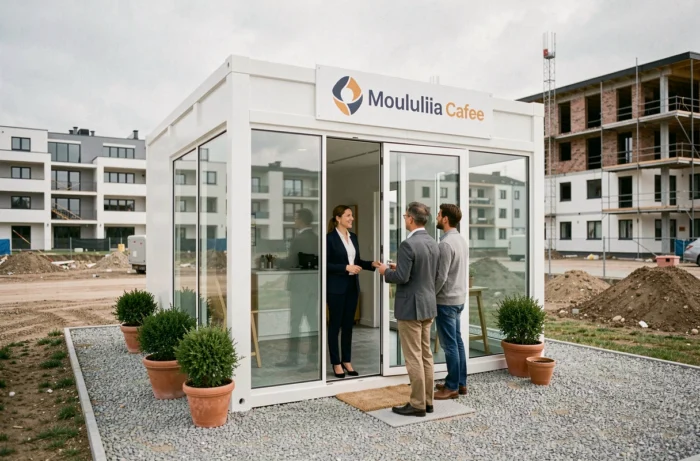
The real estate promotion market is experiencing a period of declining sales in new properties. In this context, the way a program is marketed on-site directly impacts the conversion rate of visits into contracts. Modular sales offices, located in close proximity to construction sites, serve as a marketing lever whose regulatory framework and practices have significantly evolved in recent years.
Legal Framework for Modular Sales Offices on Construction Sites
One of the historical barriers to establishing a sales space directly on a construction site was the uncertainty regarding applicable urban planning formalities. Article R*421-5 of the Urban Planning Code, in effect since September 25, 2023, clarifies this point. Installations related to the marketing of a building under construction may be exempt from formalities, up to a limit of one year, which corresponds to the typical duration of an active marketing phase.
This exemption does not mean a complete absence of constraints. Since July 1, 2023, Articles R.172-2 and R.172-4 of the Construction and Housing Code impose energy requirements adapted to temporary constructions: envelope performance, lighting, ventilation. A developer installing a sales bubble on-site must ensure that the structure meets these requirements, even for an occupancy of just a few months.
This dual framework (urban planning and energy performance) provides a solid legal basis for the establishment of modular offices while posing safeguards that CLE Immobilier modular sales offices integrate from the design of their structures.
Modular Sales Office and Customer Experience: What Changes Conversion
A sales office is not just a reception point. It is the place where a potential buyer envisions a property that does not yet physically exist. The quality of this projection largely determines their decision.
Immersion Rather Than Documentation
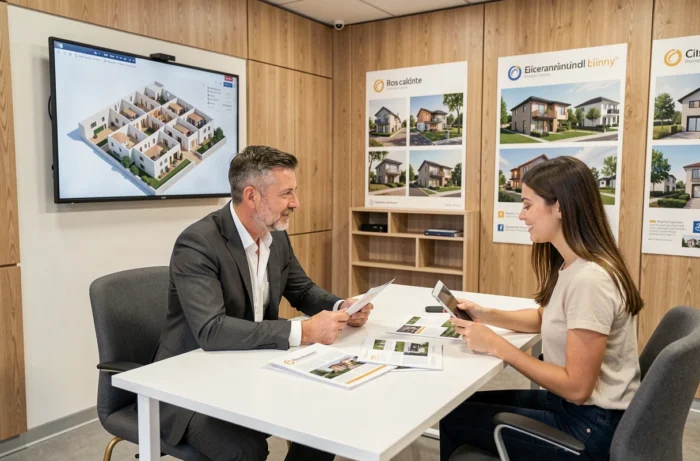
Recent modular structures allow for the integration of visualization tools (digital models, immersive screens, interactive plans) in a space designed for this purpose. Unlike a furnished show apartment set up in a temporary location, the modular office offers complete control over the ambiance: calibrated lighting, controlled acoustics, and a visitor path planned in advance.
The on-site customer experience directly influences the reservation rate. A bright, well-ventilated space where program data (plans, 3D views, financial simulations) are easily accessible reduces the number of visits needed before signing. Field feedback varies on the exact extent of this effect, but the correlation between the quality of the sales space and the speed of marketing is documented by most promotion networks.
Buyer Data Management
A well-equipped modular sales office also functions as a data collection point. The integration of a CRM directly into the sales space (connected tablets, registration kiosks) allows for:
- Qualifying visitors from the first contact and segmenting buyer profiles according to their project (primary residence, rental investment, first-time buyer)
- Tracking each client’s journey from the first visit to signing, with automated follow-ups and centralized history
- Analyzing the most consulted features on interactive supports to adjust the commercial offer in real-time
This data management capability transforms the sales office into a true commercial management tool, not just a showcase.
Cost and Logistics: The Real Trade-offs of a Modular Project
Content available on the subject often presents modular solutions as systematically cheaper than traditional construction. The reality is more nuanced.
The cost of a modular sales office depends on several variables: area, level of customization, duration of installation, access constraints to the site, and level of interior finish. A standard module costs significantly less than a permanent construction, but a highly customized space with home automation integration, bespoke furniture, and carefully designed signage can reach comparable budgets.
The economic advantage of modular solutions is mainly measured in two areas:
- The time to commissioning, which is counted in weeks rather than months, allowing for earlier marketing initiation in the project cycle
- Reversibility: a modular structure can be dismantled, moved to another program, or resold, amortizing the investment over multiple operations
- The reduction of administrative procedures thanks to the exemption regime provided by the Urban Planning Code for temporary installations related to a construction site
However, the available data does not allow for a universal cost/effectiveness ratio conclusion. Each real estate project requires a trade-off between customization and budget.
Modular Sales Offices and Environmental Performance: Obligations and Limits
The environmental issue deserves separate treatment. Since the implementation of requirements adapted to temporary constructions in July 2023, modular sales offices are no longer exempt from any energy considerations.
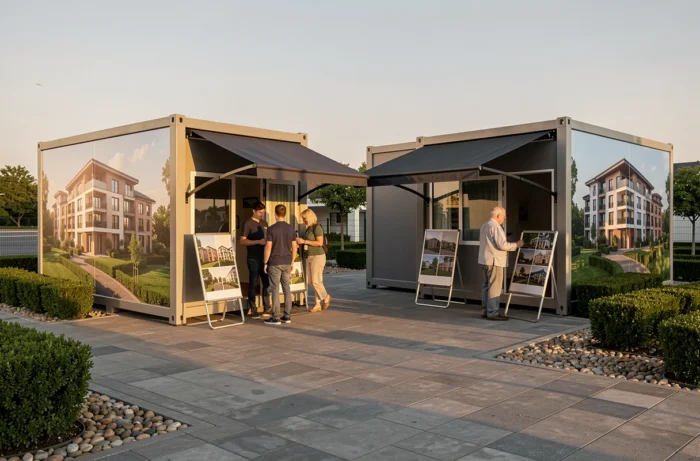
Wooden structures, highlighted by several manufacturers, offer a lower construction carbon footprint than traditional metal modules. Wood frames with bio-sourced insulation more easily meet regulatory thresholds on envelope performance.
The main limitation concerns the useful life. A modular sales office used for eight to twelve months and then dismantled generates an environmental impact that must be related to its duration of use. If the structure is reused on another program, the balance improves. If it is simply dismantled, the ecological advantage compared to a traditional solution remains debatable.
Some developers are beginning to integrate this reflection into their overall strategy, planning from the outset a reuse plan for their sales spaces. This approach aligns with the principles of the AGEC law on the circular economy, although its concrete application to modular sales offices remains marginal in the sector.
The modular sales office is not a marketing gimmick. It is a marketing tool whose effectiveness depends as much on its design as on its integration into a comprehensive sales strategy, including CRM, customer data management, and offer management. Developers who make the best use of these structures are those who view them as a measurable commercial investment, not just a simple logistical obligation of the site.