A garden that requires little intervention relies on technical choices made in advance, not on an accumulation of decorative tricks. The soil, the plant structure, and the regulatory framework condition everything else. Maintaining and designing your garden without multiplying chores requires understanding what actually generates work and eliminating it at the source.
Phytosanitary regulations and garden maintenance: what the Labbé law changes concretely
Since January 1, 2019, the Labbé law prohibits individuals from purchasing, possessing, and using synthetic phytopharmaceutical products. This includes selective herbicides for lawns, chemical moss removers, and most common fungicide treatments.
A point often misunderstood: not all “homemade recipes” are allowed. White vinegar used as a herbicide, for example, is only legal if it bears the regulatory mention EAJ (Authorized Use in Gardens) or falls under the biocontrol category. Spraying concentrated kitchen vinegar on a gravel path remains technically outside the framework.
We recommend integrating this constraint from the garden design stage. Rather than looking for a replacement product, it is more effective to eliminate the need for weeding. Persistent ground covers, mineral mulching in circulation areas, and rustic grass tolerant of weeds: these design choices drastically reduce the pressure from spontaneous weeds without resorting to any treatment.
For those who wish to discover Maison, Jardin … & Services, this integrated approach between design and maintenance aligns perfectly with the working logic of landscape professionals today.
Living soil and mulching: the technical basis of a low-maintenance garden
Mulching is mentioned in all gardening guides. What is less discussed is the difference in effect depending on the chosen material and the thickness applied. A mulch that is too thin or poorly suited to the soil exacerbates problems instead of solving them.
On clay soil, a dense organic mulch (such as BRF, fragmented branch wood) applied at a sufficient thickness limits evaporation and nourishes the soil fauna. On sandy soil, the same BRF decomposes too quickly and requires frequent renewal: a mineral mulch (slate, pumice) will be more durable there.
- BRF or pine bark on clay to loamy soil, renewed every two to three years depending on the climate
- Pumice or crushed slate on draining or sandy soil, almost no renewal needed
- Hemp or flax mulch in the vegetable garden, rapid decomposition that enriches the top layer between two crops
- Woven mulch fabric as a complement for young hedges and shrub beds, removed once the plants are established
The goal is not to cover the soil to “make it look clean,” but to maintain biological activity that structures the earth and reduces watering. A covered and living soil decreases the need for fertilizers and weeding in a measurable way season after season.
Plant layers and plant choices to reduce garden maintenance
The majority of difficult-to-maintain gardens share a common design flaw: too much lawn, not enough intermediate layers. A lawn represents the most time-demanding surface (mowing, scarifying, watering, reseeding). Reducing the grass area to the strict necessary is the most powerful lever to decrease the workload.
We observe that the most self-sufficient gardens combine three complementary plant layers:
- Lower layer: persistent ground covers (thyme, pachysandra, ground ivy) that replace grass in non-trodden areas
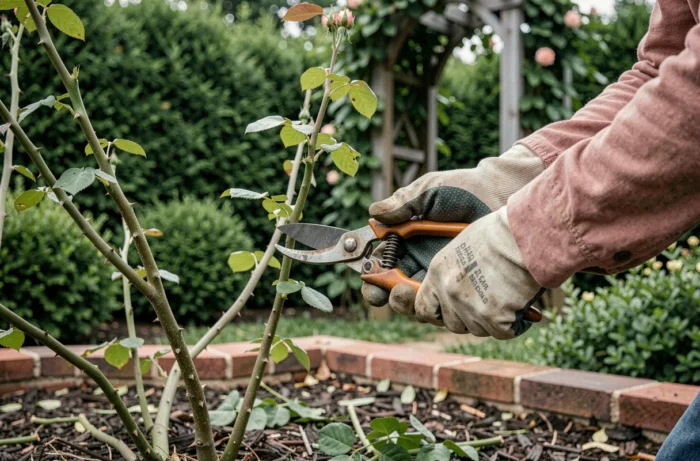
- Middle layer: naturally growing shrubs (dogwood, viburnum, eleagnus) pruned no more than once a year, or never if space allows
- Upper layer: small-growing trees (serviceberry, ornamental cherry) that structure the garden without generating an unmanageable volume of leaves in autumn
Choosing naturally growing shrubs eliminates the need for formative pruning. A forsythia planted in too narrow a space will require three interventions per year. The same budget invested in a compact deutzia or an abelia will only require a refresh after flowering.
For flowers, prefer long-lived perennials (perennial geraniums, nepeta, gaura) rather than annuals that require replanting every spring. The vegetable garden, if it exists, benefits from being concentrated on a reduced and raised surface to limit soil work.
Reasoned watering: adapting the system to the soil and climate
Manual watering with a hose remains the most time-consuming and water-wasting method. A drip irrigation system installed at the foot of the beds and controlled by a basic timer radically transforms the time spent in the garden during summer.
Dimensioning matters more than the brand of the equipment. A poorly calibrated drip system waters some areas too much and not enough others. We recommend separating circuits by type of planting: one circuit for shrubs (low flow, spaced frequency), another for the vegetable garden (higher flow during fruiting periods), and no permanent circuit for rustic grass, which must learn to seek water deeply.
The combination of mulching and drip irrigation significantly reduces the frequency of watering compared to surface watering on bare soil. This is the most cost-effective technical combination for a low-maintenance garden.
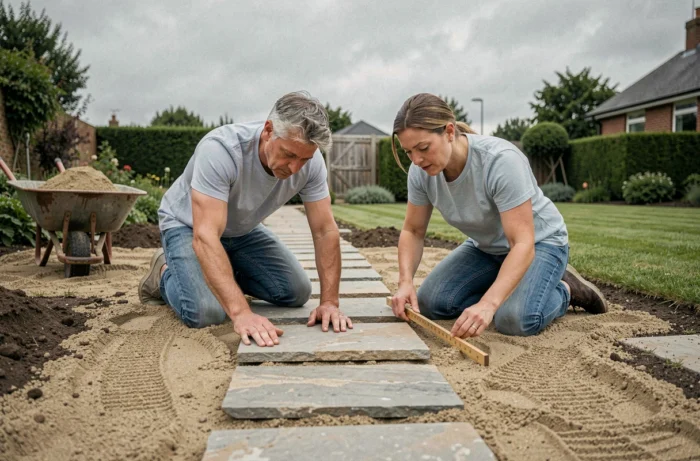
An easy-to-maintain garden does not result from a list of weekly tasks, but from structural decisions made at planting. The best maintenance is that which has been rendered unnecessary by design. Covered soil, appropriate plant layers, automated watering, and respect for the regulatory framework form a coherent whole that frees up time without sacrificing the garden’s aesthetics.