The sound system and lighting of an event are not just about plugging in speakers and pointing spotlights at a stage. Since the enactment of decree no. 2017-1244 of August 7, 2017, supplemented by an order of April 17, 2023, organizers must comply with acoustic measurement obligations that directly influence equipment choices. Regulatory thresholds, venue constraints, and the type of audience guide every technical decision, from the subwoofer to the LED projector.
Sound regulation and audio equipment: what the 2017 decree concretely changes
The French regulatory framework imposes specific thresholds for the amplification of music during public events, whether open or closed: 102 dB(A) Leq over 15 minutes and 118 dB(C) over 15 minutes. These values are not indicative; they are mandatory.
The order of April 17, 2023, strengthens these requirements by making the installation of sound level measurement and recording devices mandatory throughout the duration of the broadcast. Specifically, an organizer renting a sound system must provide a sound limiter set according to the noise impact study (EINS), which is also a mandatory document.
This framework has a direct effect on the sizing of equipment. Choosing oversized speakers for the venue no longer makes sense if a limiter restricts the output power. Conversely, an undersized system pushed to its limit produces distortion, degrades perceived quality, and strains the equipment. Browsing the equipment available at 100,000 Watts allows you to visualize the ranges suitable for different configurations, from small rooms to outdoor stages.
Law no. 2024-346 of April 15, 2024, adds another layer by establishing responsibility for abnormal neighborhood disturbance in the Civil Code. The sound emergence thresholds (5 dB(A) during the day, 3 dB(A) at night above ambient noise) expose organizers to civil lawsuits. A poorly calibrated outdoor event can lead to costly disputes.
Event sound: adapting the system to the venue rather than the budget
Most guides recommend choosing speakers based on the number of participants. This criterion matters, but it masks a more determining factor: the acoustics of the venue.
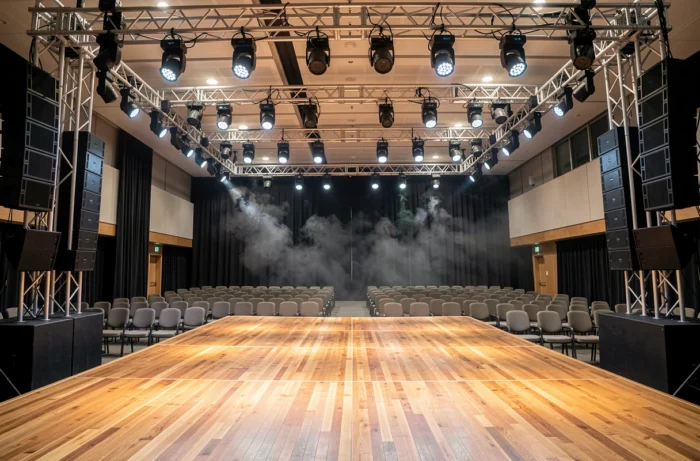
A room with concrete walls and a low ceiling generates multiple sound reflections. The sound bounces, overlaps, and loses intelligibility. In this context, increasing power exacerbates the problem. The solution lies in strategic speaker placement, the use of directed returns, and sometimes temporary acoustic treatment (absorbent panels, heavy curtains).
Outdoors, the challenge reverses. Sound disperses without obstacles, requiring more power to cover the same area. Subwoofers become necessary to maintain the depth of low frequencies, which are naturally attenuated outdoors.
Elements to evaluate before choosing an audio system
- The nature of surfaces (concrete, wood, fabric) that determines the acoustic behavior of the venue and the amount of reverberation to compensate
- The distance between the sound source and the last rows of the audience, which conditions the necessary power and the number of relay speakers
- The type of content broadcast (spoken voice, live music, DJ set), each having different frequency requirements: a conference prioritizes mids, while a concert demands a wide bandwidth response
- The regulatory constraints of the site, particularly the presence or absence of a limiter imposed by the venue manager
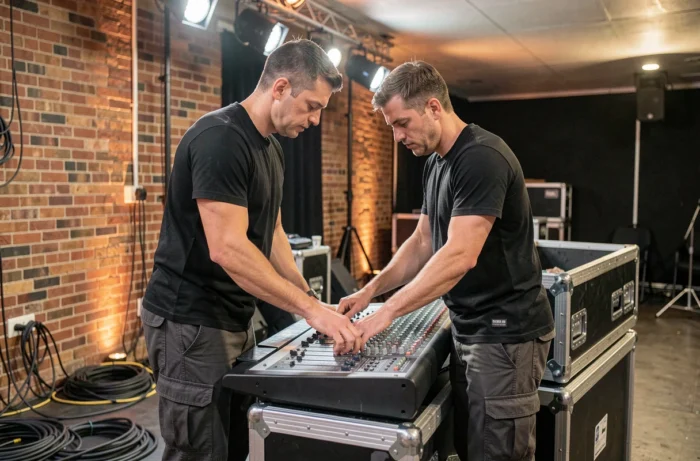
A well-suited audio system often costs less than a powerful system poorly placed. The mixing console, whether analog or digital, remains the central control point. It allows real-time adjustments of levels, equalization, and routing to different broadcast areas.
Event lighting: beyond decoration, a technical tool
Stage lighting serves two distinct functions that are often confused. The first is functional: to make visible what needs to be seen (speaker, stage, safety signage). The second is atmospheric: to create an ambiance consistent with the identity of the event.
LED spotlights have gradually replaced halogen and discharge sources at most events. Their reduced electrical consumption allows for more light points without overloading the venue’s power supply. For an outdoor event powered by a generator, this saving is not trivial.
Stage light and ambient light: two distinct logics
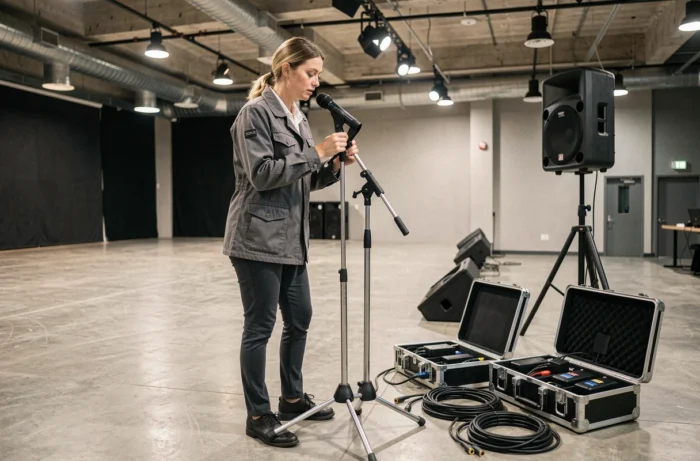
Stage light (cuts, moving heads, narrow beam projectors) focuses on a specific point. It requires calculated positioning, often from trusses or lift stands. The height and angle of projection determine the quality of the rendering much more than the raw power of the projector.
Ambient light (LED bars, washes, uplights) works in volume. It colors walls, ceilings, and circulation spaces. Its role is to guide the eye and structure the space without dazzling. RGBW LED washes offer a sufficiently wide color spectrum to adapt to most event graphic charters.
- Moving heads allow for programmed position and color changes, suitable for concerts and live performances
- PAR LED projectors are suitable for fixed installations where lighting remains stable throughout the event
- Strobes and lasers fall under the category of special effects, with specific regulations on public eye exposure
Technical coherence between sound and light: a often overlooked point
At many medium-sized events, sound and light are treated as two independent areas. Field feedback varies on this point, but technical coordination between the two departments produces a significantly superior result.
A shared DMX protocol between the lighting console and the sound control allows for the synchronization of ambiance changes with musical transitions. This synchronization does not require a huge budget, but it does demand prior preparation and compatible equipment.
Power supply constitutes another junction point. Sound and light often share the same electrical network, which can generate interference (buzzing, crackling) if the lines are not separated or filtered. Decoupling audio circuits from lighting circuits, even roughly, significantly improves the cleanliness of the sound signal.
Ultimately, the choice of audio and lighting equipment for an event relies less on brand or unit price than on the coherence of the whole. A medium system perfectly integrated into the venue, compliant with regulatory thresholds, and operated by a coordinated control will always produce a better result than an accumulation of high-end equipment poorly configured.