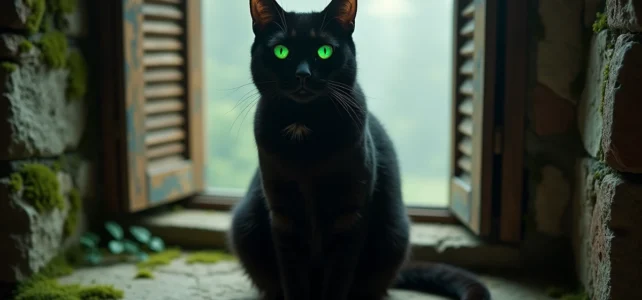
The black cat with green eyes strikes with its visual contrast, but this combination relies on a precise genetic mechanism. The color of the fur and that of the iris both depend on melanin, without being governed by the same dosage. Understanding what produces a black cat with green eyes, rather than with copper or yellow eyes, helps to untangle what belongs to biology and what belongs to cultural beliefs.
Melanin and Eye Color in the Black Cat: The Genetic Mechanism
The majority of black cats have yellow or copper eyes. Their dark fur results from a high concentration of eumelanin, the pigment responsible for dark shades. In most of these felines, this abundance of melanin is also found in the iris, producing golden or amber eyes.
Green eyes, on the other hand, correspond to a medium level of melanin in the iris. A fully black cat with green eyes thus combines two distinct traits: a coat saturated with eumelanin and an iris with moderate pigmentation. This is neither an anomaly nor an absolute rarity, but rather a particular genetic balance that explains why this combination attracts attention without being “magical.”
Exploring the significance of the black cat with green eyes leads to distinguishing this biological foundation from the symbolic interpretations that have accumulated over the centuries.
| Eye Color | Level of Melanin in the Iris | Frequency in Black Cats |
|---|---|---|
| Copper / Amber | High | Very common |
| Yellow / Golden | Medium-High | Common |
| Green | Intermediate | Less common |
| Blue | Very low (almost absent) | Rare in adult black cats |
Symbolism of the Black Cat with Green Eyes According to Cultures
The black cat has traversed civilizations with radically opposing statuses. The addition of green eyes, perceived as a bright reflection in the darkness, has often amplified symbolic projections.
Ancient Egypt and Solar Cult
The eyes of cats, reflecting light, were associated with the power of the sun god Ra. Killing a cat, regardless of its color, was punishable by death. Black cats received royal treatment: collars, earrings, mummification in sarcophagi. Their bright gaze in dark fur embodied the duality between shadow and solar light.
Medieval Europe and Association with the Devil
After the establishment of Christianity as the state religion of the Roman Empire under Theodosius, the cat gradually lost its divine status. In the Middle Ages, the black cat became the supposed companion of witches, associated with black magic and the devil. Its bright eyes in the night reinforced this reputation as an evil creature.
Japan and Black Maneki-neko
The maneki-neko (beckoning cat) exists in a black version. In Japanese tradition, the black cat protects against evil spirits and negative energies. Far from bringing bad luck, it serves as a domestic talisman.
These divergent readings show that the symbolic charge of an animal entirely depends on the cultural context, not its biology.
Adoption of Black Cats: A Persistent Discrimination in Shelters
Superstitious beliefs have measurable consequences. British and American shelters report that black cats are adopted less quickly than others. Two factors combine:
- Prejudices inherited from medieval superstitions, still present among part of the public
- A photographic bias: black cats do not photograph well on social media, reducing their visibility in online adoption ads
- A lesser perceived “visual differentiation” between black individuals compared to tabby or bicolor cats
Aware of this bias, awareness campaigns are attempting to correct it. Black Cat Appreciation Day, celebrated in several English-speaking countries, highlights the qualities of these felines. Some shelters organize specific operations with reduced rates or tailored photographic showcases.
Black Cat with Green Eyes as a Totem Animal: What Spiritual Traditions Say
In traditions related to totem animals, the black cat with green eyes occupies a special place. Its dark fur is read as a symbol of mystery and introspection, while its green eyes evoke intuitive perception.
Several spiritual traditions assign it specific symbolic functions:
- Energy protection of the home against negative influences
- Invitation to explore one’s own shadow areas and develop intuition
- Sign of personal transformation, with black representing the end of a cycle and green a renewal
These interpretations do not fall under science, but they fuel a growing interest in the spiritual symbolism of the cat in the domestic space. The totem animal cat is associated with independence, curiosity, and a form of clairvoyance in many cultures.
The distinction between scientific approach and symbolic reading remains the thread that runs through this topic. Genetics explains why some black cats have green eyes, while human cultures project varying meanings onto this combination from continent to continent. A black cat with green eyes remains above all a domestic feline whose gaze captures light in a particular way, which is more than enough to justify the fascination it inspires.