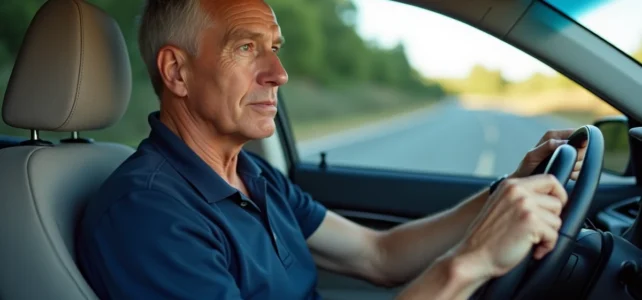
After a stroke, even a mild one, you don’t just get back in the car as if nothing happened. The driving license is not automatically revoked, but it is no longer valid without a medical check-up. French regulations require a specific process before resuming driving, and failing to follow these steps can lead to concrete penalties, including in the event of an accident covered by insurance.
Invisible aftereffects after a stroke and driving ability
We first think of visible aftereffects: hemiplegia, speech disorders, loss of fine motor skills. However, experiences from post-stroke rehabilitation show that invisible aftereffects compromise driving ability more than motor deficits. Post-stroke fatigue, attention disorders, and slow information processing affect a significant proportion of patients, including those who walk normally and speak without difficulty.
In practical terms, we are talking about a driver who brakes half a second too late at a traffic light, who fails to detect a vehicle approaching from the right, or who loses track on a familiar route. These deficits are not visible during a standard consultation. This is why rehabilitation teams increasingly recommend a specific neuropsychological evaluation before validating the return to driving.
To understand the validity of the license after a stroke according to Geek Medical, one must first recognize that the status of the license changes upon diagnosis, without any official letter necessarily being sent to the driver.

Temporary incompatibility of the license: what the regulations say
The decree of August 31, 2010, classifies stroke among the conditions that lead to a temporary incompatibility with driving. The duration of this incompatibility varies depending on the nature of the deficit and the severity of the episode.
- After a minor stroke without rehabilitation, a minimum waiting period of fifteen days applies before any resumption, followed by a mandatory consultation with a doctor approved by the prefecture.
- After a moderate to severe stroke requiring rehabilitation, a multidisciplinary assessment of driving ability can only take place at least one month after the incident, often much later in practice.
- For TIAs (transient ischemic attacks), temporary incompatibility is also declared, even if symptoms have disappeared within a few hours.
A stroke is one of the medical conditions that must be reported to the prefecture when they may compromise driving ability. This declaration can lead to a summons before an approved doctor or the departmental commission for licenses, even in the absence of a traffic violation. In clear terms, you do not wait for an accident to be checked.
Medical visit for the license after a stroke: concrete process
The visit to the approved doctor is not a mere formality. The doctor assesses motor, sensory, visual, as well as cognitive and behavioral abilities. We talk about reaction times, divided attention, and the ability to manage multiple pieces of information simultaneously.
Three outcomes are possible from the examination:
- Favorable opinion without restrictions: the license is renewed for a limited duration (often one year, sometimes two), with the obligation to undergo the visit again at the due date.
- Favorable opinion with vehicle adaptations: automatic transmission required, adapted steering wheel, additional mirrors. These restrictions are noted on the license in the form of codes.
- Unfavorable opinion: the license is suspended. A new evaluation may be requested after a period of additional rehabilitation.
Feedback varies on this point, but the visit generally lasts between twenty and forty minutes. Some approved doctors require a prior neuropsychological assessment, while others do not. It is better to arrive with recent medical reports and, if possible, a neuropsychological assessment already completed at a rehabilitation center.
Annual check and license renewal
When the approved doctor issues a favorable opinion after a stroke, the license is always issued for a limited duration. Periodic checks are required, often annually in the first year, then spaced out if the neurological condition remains stable. Driving beyond the validity date indicated on the medical opinion amounts to driving without a valid license.
Double medical-psychological filter in case of license withdrawal
When a driver with a history of stroke faces a license withdrawal (long suspension, cancellation, invalidation), recovery goes through a double filter: mandatory medical visit and psychotechnical tests. This system, required after more than six months of suspension, is regularly used for post-stroke drivers exhibiting persistent cognitive or attention disorders.
The psychotechnical tests assess reflexes, coordination, selective attention, and resistance to fatigue. They complement the opinion of the approved doctor and can, on their own, block the return of the license if the results are insufficient.
Insurance risk not to be overlooked
Resuming driving without having completed the mandatory medical visit after a stroke is not just a violation of the highway code. In the event of an accident, the insurer may invoke the nullity of the license to refuse any compensation. One then finds oneself personally liable, including for bodily harm caused to others.
The license after a stroke is not an acquired right; it is a conditional title. Each medical renewal confirms or denies the ability to drive. Keeping medical reports up to date, anticipating appointment delays with the approved doctor (sometimes several weeks), and not driving between medical opinions remain the three reflexes to adopt to avoid a complicated administrative and legal situation.