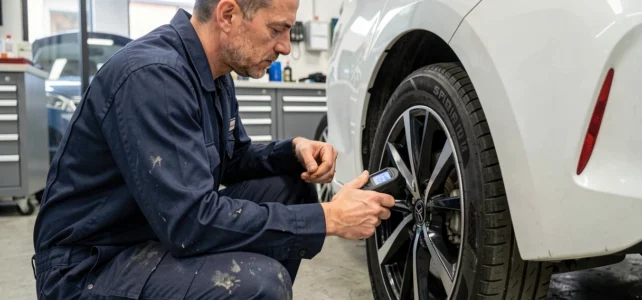
On a a Toyota Yaris hybrid, losing 0.2 bar on all four tires is enough to force the internal combustion engine to run more often. The hybrid system XP210 alternates between electric and thermal traction depending on the resistance encountered. When the tires are under-inflated, this rolling resistance increases and the electric driving phases shorten.
The actual consumption then diverges from the advertised values. This is a parameter that directly affects both the wallet and the mechanics, not just comfort.
Tire pressure and Yaris XP210 hybridization: a direct link to consumption
The Yaris hybrid XP210 is particularly sensitive to even moderate under-inflation. Recent test feedback confirms that the internal combustion engine kicks in more often as soon as the pressure drops below the label values. On the highway, where rolling resistance weighs more heavily, the car loses a measurable part of its fuel efficiency advantage.
In practice, it is observed that drivers who strictly adhere to the manufacturer’s values achieve actual consumption close to the advertised figures. Those who let the pressure drop by a few tenths of a bar notice a significant increase at the pump, without necessarily understanding where it comes from.
To delve deeper into tire pressure on the Toyota Yaris hybrid, the values vary according to the size of the tires fitted and the load level. The common point remains the same: on this model, every tenth of a bar matters more than on a conventional thermal city car.
Recommended pressure values according to Yaris hybrid tire size

You don’t inflate a Yaris hybrid randomly. The values depend on the size of the original tires and the load carried. Here are the guidelines provided by the manufacturer:
| Tire size | Front pressure (bar) | Rear pressure (bar) | Front loaded (bar) | Rear loaded (bar) |
|---|---|---|---|---|
| 175/65 R15 | 2.3 | 2.2 | 2.5 | 2.4 |
| 185/60 R15 | 2.2 | 2.2 | 2.3 | 2.3 |
| 195/50 R16 | 2.3 | 2.2 | 2.5 | 2.4 |
The label affixed to the driver’s door pillar remains the absolute reference. If it has disappeared or if the tires no longer match the original dimensions, refer to the vehicle manual.
The difference between “normal” pressure and “loaded” pressure is not trivial. Going on vacation with four passengers and a full trunk without adjusting the pressure amounts to driving with relative under-inflation, with all the negative effects on road handling and consumption.
Cold tire pressure check: the field method
It is often said that tire pressure should be checked “cold.” In practice, this means that the vehicle has not been driven for at least two hours, or less than three kilometers at low speed. Inflating after thirty minutes on the highway skews the measurement by about 0.3 bar, which is enough to exceed the target values unknowingly.
Here is the sequence we recommend:
- Check the pressure on all four wheels (and the spare tire if present) with a reliable gauge or the station’s pump, vehicle cold.
- Compare each reading with the value indicated on the door pillar label, taking into account the expected load level.
- Adjust in small successive increments, rechecking after each addition, as station pumps are not always perfectly calibrated.
- Replace the valve cap properly: an absent or poorly screwed cap allows air to escape slowly, which goes unnoticed for weeks.
The ideal frequency for checking is about once a month. Before a long trip or a change of season, an additional check is added.
TPMS warning light on Yaris hybrid: understand before acting
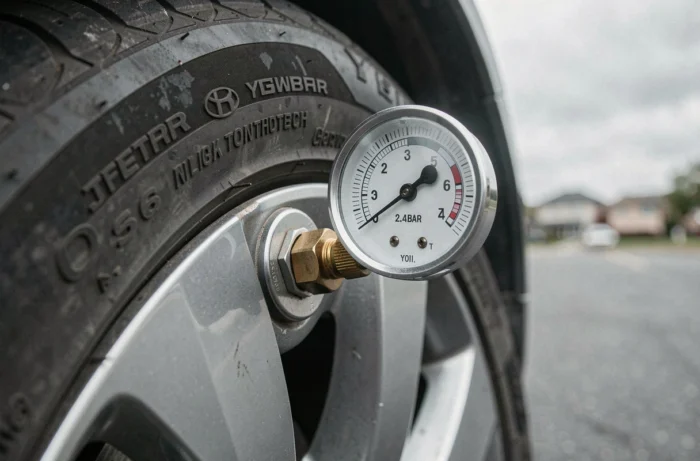
The TPMS (Tire Pressure Monitoring System) of the Yaris hybrid continuously monitors the pressure of each wheel. When the warning light comes on, two scenarios arise.
The light stays on: at least one tire is below the minimum pressure threshold. Inflate cold to the manufacturer’s values, then drive a few kilometers. The light should turn off by itself.
The light blinks then stays on: the system itself is faulty. This often happens after a tire rotation or wheel change without resetting the sensor. On the Yaris hybrid, the TPMS reset procedure usually goes through the dashboard menu (hold the “SET” button until the light blinks). Feedback on this point varies according to the version of the onboard system.
Do not ignore a persistent TPMS light. Beyond the road safety risk, an unresolved TPMS fault can lead to a refusal at the technical inspection due to the strengthening of obligations related to pressure monitoring systems.
Summer, winter, highway: adjust Yaris tire pressure to the real context
The pressure in a tire varies with ambient temperature. In winter, a properly inflated tire in October can fall below the recommended values as soon as the first frosts, without any leak being involved. The opposite phenomenon occurs in summer, where the heat of the pavement and speed combined can raise the pressure beyond target values.
On the highway, the Yaris hybrid demands more from the internal combustion engine and the tires heat up faster. Never deflate a hot tire to return to the “label” value: the pressure will naturally drop as it cools, and deflating when hot guarantees under-inflation as soon as it stops for an extended period.
The most reliable reflex remains to always measure and adjust when cold, taking the load context into account. A properly inflated tire on a Yaris hybrid protects the hybrid mechanics, reduces consumption, and preserves the tread evenly, which extends the lifespan of the set of tires.