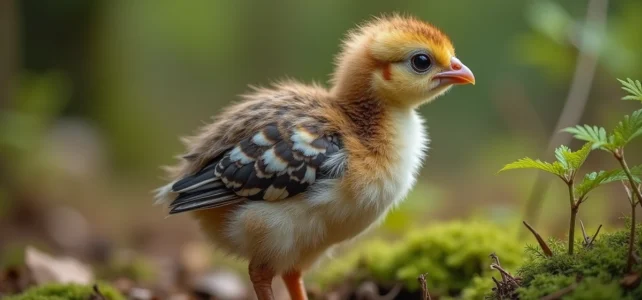
The pheasant chick, the name given to the young pheasant, emerges from the egg covered in a subtle down that makes it difficult to distinguish from other game bird chicks. Recognizing a baby pheasant requires observing precise details of plumage, morphology, and behavior from the very first hours of life. This identification also raises questions about breeding conditions, as recent health and climate constraints are changing the landscape for game breeders in France.
Pheasant Chick Down: Visual Clues from Hatching
At birth, the pheasant chick has light brown down streaked with dark lines on its back and head. This camouflage, typical of precocial birds, allows it to blend into the low vegetation. The most common confusion occurs with partridge or quail chicks, which share a similar size and color palette.
Several details help to differentiate them. The legs of the pheasant chick are proportionally longer than those of a chicken chick of the same age. The beak is slender and slightly curved, adapted for catching insects. The ocular line, a dark band that runs from the beak to the back of the head, is more pronounced in pheasants than in gray partridges.
To delve deeper into the development of the baby pheasant, attention should also be paid to the tail: even though it is short at the down stage, it already slightly exceeds that of other game birds of the same age, a sign of the long tail feathers of the adult male to come.
Feeding Pheasant Chicks During the First Weeks
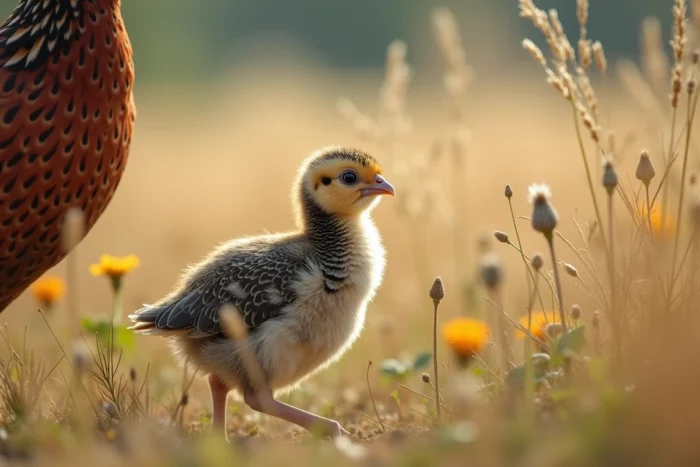
Young pheasants do not eat the same food as adults. During the first three weeks, pheasant chicks feed almost exclusively on insects. Beetles, ants, larvae: this source of animal protein determines the growth rate of juvenile plumage and the proper development of the skeleton.
This insectivorous diet poses a concrete problem in breeding. In an aviary, the natural availability of insects is low. Breeders compensate with high-protein starter feeds, provided in the form of fine crumbs. The food must remain accessible at all times, along with clean, lukewarm water.
- From hatching to three weeks: an almost exclusively insectivorous diet (or high-protein starter feed in breeding)
- From three to six weeks: gradual transition to seeds, tender leaves, and small plants
- After six weeks: mixed diet comparable to that of adults, with an increasing proportion of plant matter
In the wild, the female pheasant guides her chicks to areas rich in invertebrates, often the edges of hedges or the borders of unmown fields. The quality of the habitat directly determines the survival of the chicks during the first weeks.
Thermal Stress and Mortality of Young Pheasants in Breeding
Online resources rarely describe the impact of climate on pheasant chicks. Heatwaves, more frequent in recent years, cause a marked over-mortality among young poultry, including pheasants. Agricultural organizations have repeatedly reported the need to adapt breeding buildings and bird density per enclosure to limit losses.
A dehydrated pheasant chick stops feeding, groups with others under the few shaded areas, and quickly loses weight. This grouping behavior, easy to observe, serves as a warning signal for the breeder. The response must be immediate: misting, increased access to water, and reduced density in the pen.
Pheasant chicks are more sensitive to thermal stress than chicken chicks, partly because their finer down offers poorer regulation. In nature, the female pheasant compensates by choosing shaded nesting sites, but pheasant chicks raised in captivity and released in the middle of summer do not benefit from this maternal learning.
Juvenile Plumage of the Pheasant: Recognizing Males and Females
Sexual dimorphism, spectacular in adults, remains invisible during the first weeks. Males and females wear the same striped brown down, then the same dull juvenile plumage. Distinction only becomes possible around the sixth week, when the first colored feathers appear on the chest and flanks of young males.
Before this stage, no reliable visual criteria allow for sexing a pheasant chick. Field reports differ on this point: some breeders claim to spot males by their more active behavior or slightly larger size, but these indicators remain anecdotal and unverified scientifically.
Evolution of Plumage Between Six and Twelve Weeks
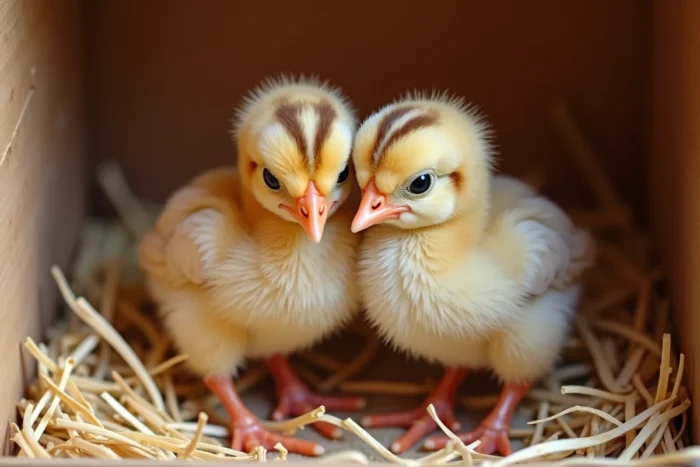
In the young male, iridescent green feathers first appear on the neck, while the tail begins to noticeably lengthen. The female retains a spotted brown plumage, similar to that of the down but with clearer bars. By twelve weeks, the dimorphism is pronounced enough to identify the sexes without hesitation.
This transition period also corresponds to the time when pheasant chicks become independent in their feeding. They shift from a supported diet (in breeding) or one guided by the hen (in nature) to actively foraging for seeds and insects in their enclosure or environment.
Avian Influenza and Health Constraints for Pheasant Breeding
The French health framework directly impacts the breeding conditions of pheasant chicks. During the recent season, over a hundred outbreaks of highly pathogenic avian influenza have been detected in France, according to the Ministry of Agriculture. Feathered game farms, including pheasants, are subject to the same biosecurity obligations as domestic poultry farms.
- Mandatory confinement or sheltering of birds during periods of high risk, limiting the access of pheasant chicks to outdoor ranges
- Enhanced veterinary surveillance and mandatory reporting of any abnormal mortality in the breeding operation
- Transport and release restrictions for game in regulated areas, which can delay restocking schedules
These constraints alter the developmental timeline of young pheasants in breeding. A pheasant chick confined longer in an aviary develops less of its flying and orientation abilities, which reduces its chances of survival after being released into the wild. Hunting federations are gradually adapting their protocols, but the available data does not yet allow for precise measurement of the impact on recovery rates.
Recognizing a baby pheasant relies on subtle details (leg length, ocular line, beak shape) that fade within a few weeks in favor of juvenile plumage. In terms of breeding, the first weeks concentrate most of the risks: inadequate feeding, thermal stress, health pressures. Observing these stages closely remains the best way to distinguish a pheasant chick from another game bird and to provide it with viable growth conditions.