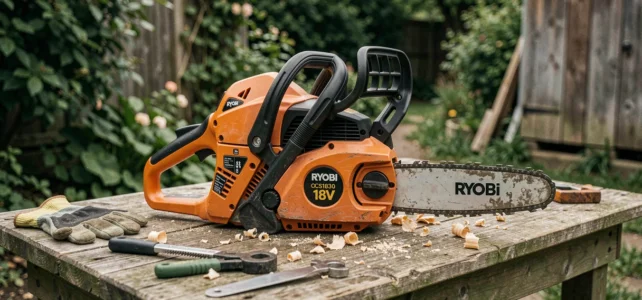
The Ryobi OCS1830 occupies a specific niche: that of the 18V battery chainsaw designed for individuals who already own one or more tools from the ONE+ range. But how does this machine actually measure up against its advertised specifications, and more importantly, what is the real cost for a user starting from scratch? This is what we assess here, backed by technical data.
Technical specifications of the Ryobi OCS1830 against the manufacturer’s promises
| Feature | Manufacturer Data | Field Observation |
|---|---|---|
| Voltage | 18V ONE+ | Compatible with all existing ONE+ batteries |
| Motor Type | Brushless | Less heating, extended runtime compared to a brushed motor |
| Guide Bar | 30 cm | Suitable for logs of small to medium diameter |
| Chain Speed | 10 m/s | Clean cut on softwood, slower on hardwood |
| Weight (without battery) | 3.2 kg | Manageable with one hand for short sessions |
| Lubrication | Automatic | Reservoir to monitor during prolonged cuts |
| Chain Tensioner | Tool-less | Quick adjustment, accessible for beginners |
| Battery Included | No | Significant additional cost if the user does not own a ONE+ battery |
This table highlights a point that product listings often relegate to the bottom of the page: the machine is sold without a battery or charger. For someone new to the Ryobi ONE+ ecosystem, the actual entry budget far exceeds the displayed price of the bare tool.
To delve deeper into this point and other user feedback, our review of the Ryobi OCS1830 18v details the performance measured on different types of wood.
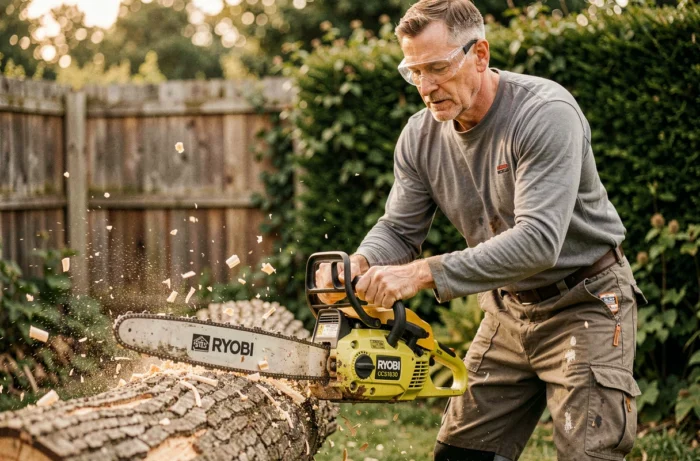
18V Brushless Motor: What the increased runtime means in practice
The Brushless technology is not just a marketing gimmick for this machine. The absence of mechanical friction between the brushes and the rotor produces two concrete effects: the motor does not heat up as much as a conventional motor during repeated cuts, and the lifespan of the motor block is significantly extended.
In practice, this means that a ONE+ battery of the same capacity delivers more cuts on the OCS1830 than on an equivalent brushed model. The Brushless motor makes better use of each charge cycle.
Limitations of 18V compared to 36V
The 18V format imposes a power ceiling. On softwood (poplar, pine), the chain speed of 10 m/s is sufficient to produce a clean cut. On hardwood (oak, dry beech), the chain noticeably slows down and the required pressure effort increases.
For regular felling of trunks exceeding the 30 cm guide diameter, a 36V chainsaw would be more suitable. The OCS1830 remains a lightweight logging and pruning tool, not a heavy-duty forestry machine.
Real cost of entry into the Ryobi ONE+ ecosystem
This is the angle that most comparative tests overlook. The Ryobi OCS1830 displays an attractive price in the “bare tool” version. But this data is misleading for a new user.
- The bare tool does not include a battery or charger, making it unusable right out of the box
- A Lithium+ ONE+ battery and its charger represent an additional cost that can approach or exceed the price of the chainsaw itself
- For a user already equipped with Ryobi ONE+ tools (drill, blower, mower), the battery is already in the garage and the entry cost drops drastically
This platform logic is the real economic argument for the OCS1830. Buying this chainsaw as a first Ryobi tool only makes sense if one plans to acquire other ONE+ machines afterward. The pooling of batteries across the entire range ultimately amortizes the initial investment.
Safety and ergonomics: chain brake and handling
The OCS1830 includes a quick chain brake, a safety feature that some entry-level battery chainsaws do not offer. In the event of a kickback, the brake stops the chain almost instantly.
The front handle, wrapped in rubber, absorbs some of the vibrations. At 3.2 kg without the battery, the machine remains lightweight for short pruning or log cutting sessions. During prolonged cuts, fatigue is felt more in the wrist than in the arms, a sign that the center of gravity is well placed but that the weight of the battery alters the balance.
Tool-less chain tensioner: a real time saver
The chain tension adjustment is done by hand, without a wrench or screwdriver. For an occasional user who does not want to search for a toolbox at every session, this detail makes a difference. The chain naturally loosens after a few cuts. Being able to retighten it in seconds avoids interruptions and reduces the risk of derailment.
Ryobi OCS1830: for which user profile
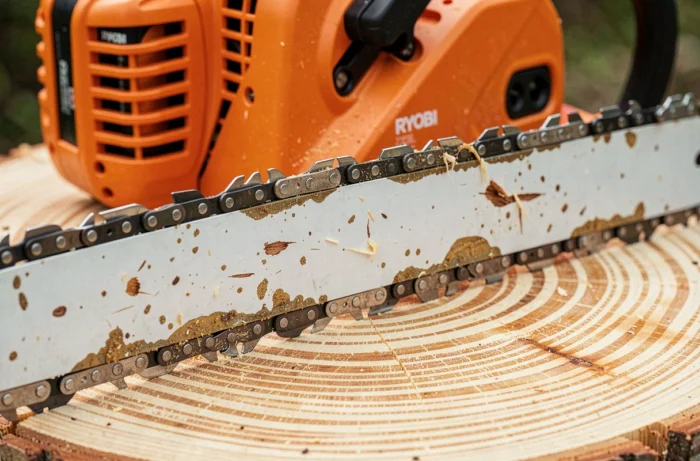
The technical data points to a fairly clear profile. This chainsaw is suitable for an individual maintaining a landscaped garden, cutting small firewood, or pruning branches up to a reasonable diameter dictated by the 30 cm guide.
- Occasional logging on soft to medium hardwood: well suited
- Pruning low branches and cleanup after storms: ideal use
- Felling thick trunks or intensive work on hardwood: underpowered
The Brushless motor and ONE+ compatibility remain the two structural advantages of this machine. Its economic interest entirely depends on the number of ONE+ tools already owned. For a user isolated from the Ryobi ecosystem, the performance/total cost ratio is less favorable than for an already equipped user.
The key takeaway before any purchase remains this: check if a compatible ONE+ battery is already available at home. This single parameter shifts the verdict from a questionable investment to a coherent choice.