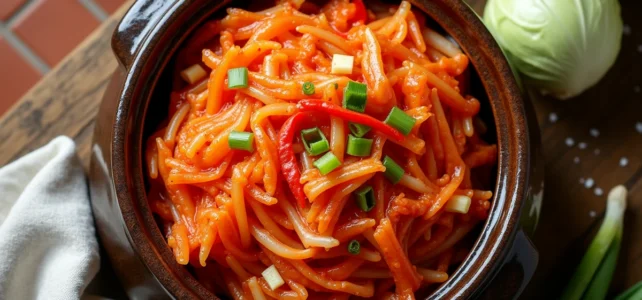
Kimchi relies on natural lacto-fermentation, a process where lactic acid bacteria acidify the environment and make the proliferation of pathogens very difficult. However, the question of botulism often arises among people who prepare their homemade kimchi. The real risk does not lie in the kimchi itself, but in recipe or storage errors that prevent the acidification from playing its protective role.
Lacto-fermentation and anaerobic preserves: two distinct levels of risk
| Parameter | Kimchi (lacto-fermentation) | Vacuum-packed / oil preserves |
|---|---|---|
| Environment | Salt brine, lactic acid production | Strictly anaerobic, little to no natural acidification |
| Final acidity | pH quickly dropping below 4.6 | Variable, sometimes above 4.6 |
| Salt | Present in quantity (brine) | Absent or low depending on the recipe |
| Intrinsic botulism risk | Very low if the process is followed | Higher without proper sterilization |
| Documented cases | Extremely rare | Majority of foodborne botulism cases |
The bacterium Clostridium botulinum needs a low-oxygen, low-acid, and low-salt environment to germinate and produce its toxin. Properly salted and fermented kimchi rarely meets these criteria: the brine and gradual acidification create a hostile environment for this bacterium.
To better understand the dangers of botulism in kimchi, one must look at the specific conditions that would shift a safe preparation into a risk zone.
Oil or vacuum-packed preserves, on the other hand, do not benefit from this natural acidification. It is in these preparations that the vast majority of foodborne botulism cases are recorded in France.
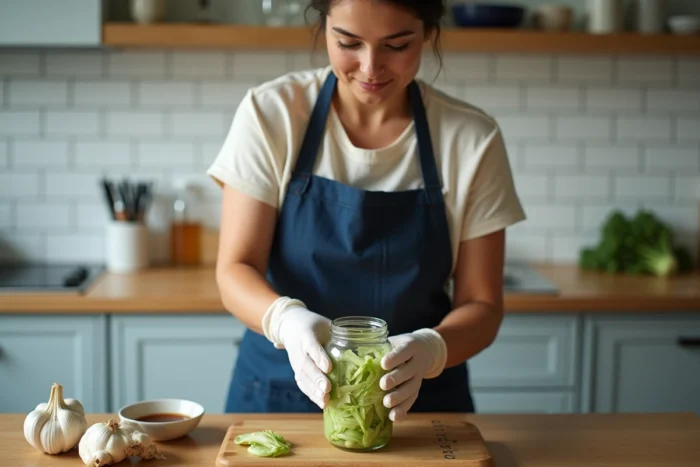
Recipe and storage errors that create a real risk of botulism
The problem never comes from well-made kimchi. It arises from approximate recipes or unsuitable storage conditions that block lactic fermentation before it has made the environment sufficiently acidic.
Insufficient salt dosage
Salt serves a dual purpose: it inhibits undesirable bacteria during the first hours and promotes the growth of lactic acid bacteria. A dosage that is too low leaves a window where pathogens can multiply before acidity takes over.
Fermentation interrupted too early
Kimchi placed in the refrigerator before the pH drops below 4.6 has not reached the safety threshold. Botulinum toxin is produced in environments where the pH remains above this value. Allowing fermentation to occur at room temperature for the necessary duration (which varies depending on the recipe and season) is a safety step, not just a matter of taste.
Adding oil or immersion in a fatty substance
Some variations of kimchi or fermented vegetables include oil on the surface. This action creates an anaerobic layer that can trap pockets without acid, exactly the type of environment that Clostridium botulinum seeks. Oil and lacto-fermentation do not mix well from a safety standpoint.
Prolonged storage outside refrigeration after opening
Mature and acidic kimchi remains stable in the refrigerator for weeks. Left at room temperature in an opened jar, the situation changes: the microbial load evolves, and an environment that was safe can drift if other conditions deteriorate.
Acidity, salt, and cold: the three concrete barriers against Clostridium botulinum
Recent recommendations converge towards a cumulative barrier approach. No single measure is sufficient, but their combination makes the risk negligible.
- Measurable acidity: the pH must drop below 4.6 for botulinum toxin production to be inhibited. pH strips or a pH meter can verify this threshold, something that smell or visual appearance cannot do (the toxin is odorless, colorless, and tasteless).
- Salt in appropriate proportion: a sufficient salt level in the brine ensures that lactic acid bacteria dominate the environment from the start of fermentation. Traditional Korean recipes use generous salting of the cabbage before rinsing, which gives the right ratio.
- Refrigeration after fermentation: cold slows any residual microbial activity and stabilizes the product over time. For preparations stored for long periods, this additional barrier is particularly recommended.
The combination of these three parameters explains why traditional kimchi has survived for centuries without posing major health issues. Incidents occur when one or more of these barriers are absent.
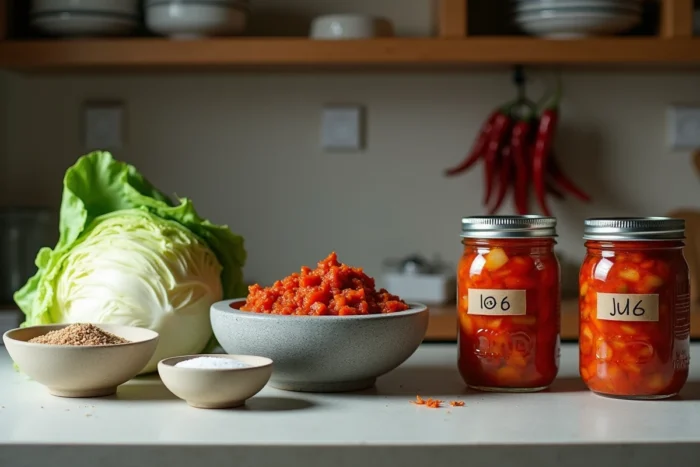
Homemade kimchi and detecting a problem: what your senses cannot perceive
A often underestimated point: botulinum toxin cannot be detected by smell, taste, or appearance. A jar of kimchi may seem perfectly normal while harboring a dangerous environment if the process has been poorly conducted.
The classic signs of failed fermentation (visible mold, putrid smell, slimy texture) indicate other contaminations, not botulism. This distinction is crucial: the absence of visible signs guarantees nothing if the recipe parameters have not been respected.
This is why measuring pH remains the only reliable check for an individual. A minimal investment (a few euros for strips) that transforms uncertainty into concrete data.
What distinguishes safe kimchi from risky kimchi
- The salt has been dosed according to a proven recipe, not reduced “for health” without compensation.
- The fermentation lasted long enough at room temperature for the acidity to reach a pH below 4.6.
- No fatty substance was added to the jar before or during fermentation.
- The jar is kept in the refrigerator once fermentation is complete.
- The pH has been checked at least once with a measuring tool, not just by taste.
Botulism related to homemade kimchi remains a theoretical risk more than a practical one, provided the fundamentals of lacto-fermentation are respected. Real cases of foodborne botulism almost exclusively involve oil preserves, vacuum-packed items, or inadequately sterilized products. Well-salted, well-fermented kimchi stored in the cold accumulates enough barriers to make the proliferation of Clostridium botulinum nearly impossible.