
The facades endure varying volumes of water each winter, but recent trends call for vigilance. The High Council for Climate notes that the storms of January-February 2026 saw the intensity of extreme rainfall increase by about 10% compared to the past climate. Inspecting your facade in spring is no longer just a precaution: it’s maintenance that should be integrated into the calendar, just like bleeding radiators before autumn.
Micro-cracks after rain: what frost causes in the plaster
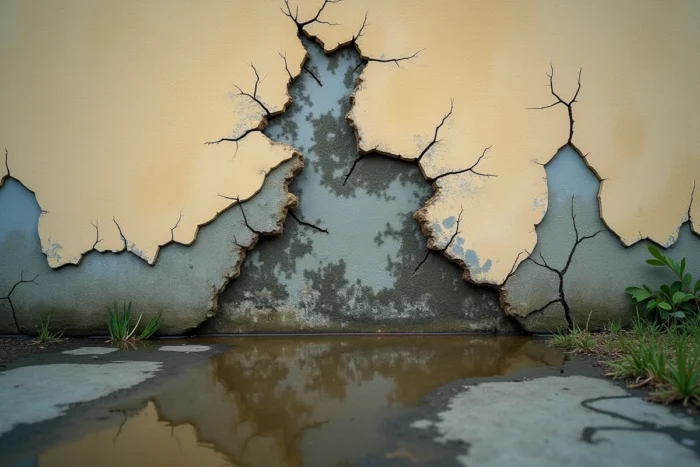
The most deceptive damage is that which is not visible from a distance. A micro-crack of a few tenths of a millimeter in cement or lime plaster can remain invisible for months. Rainwater infiltrates it by capillarity, then freezes inside the material when nighttime temperatures drop below zero.
The freeze-thaw cycle gradually widens the crack. Each freezing night acts like a wedge: the water expands as it solidifies, exerting mechanical pressure on the edges of the crack, which opens a little more during the next thaw. After a winter where rain and frost alternate frequently, these micro-cracks can reach a width sufficient to be detected by the naked eye.
To spot them, the most reliable method is a close examination in dry weather, in low light (morning or late afternoon). Run your hand over the plaster: healthy plaster offers a smooth surface, while plaster weakened by frost sounds hollow when tapped and may flake off. Engaging a facade cleaning company allows for a combination of spring cleaning and an initial visual diagnosis of these weakened areas.
Green, black, or reddish stains on exterior walls: identifying the cause
The discolorations that appear on a facade after winter are not all of the same nature, and their treatment varies radically depending on the source.
- Green stains (algae and moss) develop in persistently damp areas, particularly on north-facing facades or those sheltered from the wind. They indicate surface water retention, often linked to a porous plaster or an overflowing gutter.
- Black stains generally come from microscopic fungi or urban pollution fixed by moisture. Their presence indicates that water stagnates long enough to allow for biological colonization.
- Reddish or ochre stains, which are less common, may reveal oxidation of metallic components integrated into the wall (reinforcements, fasteners) or leaching of clay soils from the upper part of the facade.
A often overlooked point: the color of the stain indicates the depth of the problem. A surface green moss can be cleaned easily. A persistent black stain after high-pressure cleaning suggests that moisture has penetrated deeper into the material, and a simple wash will not suffice.
Water infiltration through the facade: visible signs from the inside
External signs tell only part of the story. After a rainy winter, it is often inside the dwelling that infiltrations manifest first, sometimes weeks after the last rain episode.
Yellow or brown halos on interior walls, especially near windows or at the lower part, are the most common signal. Water that has passed through the exterior plaster migrates slowly into the wall by capillarity and eventually reaches the interior facing. This phenomenon is particularly frequent on old stone or brick walls, whose joints age and lose their watertightness.
Another sign to watch for: efflorescence, this whitish and powdery deposit that appears at the bottom of interior walls. It results from the crystallization of mineral salts transported by water through the masonry. Its presence confirms active capillary rise or lateral infiltration.
The smell of mildew in a room that faces an exterior wall also deserves attention. Even without visible stains, it can signal trapped moisture within the thickness of the wall, between the exterior plaster and the interior lining.
Vulnerability points often overlooked during facade inspection
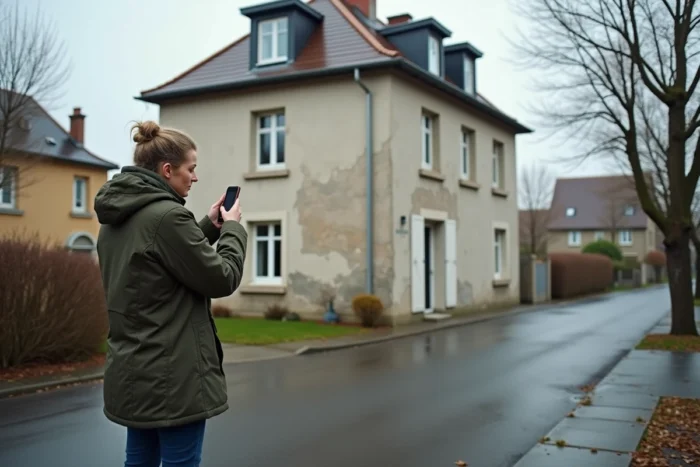
The majority of post-winter infiltrations do not occur through the middle of the wall, but through junction points. Three areas concentrate most of the pathologies.
Seals of exterior joinery (windows, doors, roller shutter boxes) are the first to be concerned. A silicone or acrylic seal has a limited lifespan, and winter thermal variations accelerate its aging. A detached or cracked seal allows water to pass directly into the frame, then into the wall.
Window sills deserve special attention. A sill with insufficient slope or whose drip edge (the groove under the sill that forces the water droplet to fall) is blocked by paint or plaster redirects water towards the facade instead of away from it.
The connections between the facade and added elements (downspouts, meters, electrical boxes) create micro-spaces where water accumulates. After a rainy winter, check that the fixings have not moved and that the connection sealants are intact.
Facade moisture diagnosis: when to move from visual inspection to measurement
Visual inspection has its limits. It detects symptoms, not always the cause or the actual extent of the problem. The 2025 Report from the Construction Quality Observatory ranks water and humidity-related pathologies at the top of the reported disorders in French buildings. This finding advocates for an instrumented diagnosis as soon as visual signs multiply.
A surface moisture meter, available for a few dozen euros, allows for an initial assessment. However, field feedback varies on the reliability of these consumer devices, whose measurements fluctuate depending on the type of material and ambient conditions. For a thick stone or brick wall, a deeper probe (measuring by electrical resistance or microwaves) provides more usable results.
Engaging a professional diagnostician is justified in three cases: evolving cracks (that widen from one season to the next), visible active infiltrations inside, or recurring efflorescence despite surface treatments. The diagnosis will distinguish simple plaster porosity, treatable with water repellents, from a structural defect that requires masonry repair.
Post-winter facade inspection is best conducted between March and May, when the walls are still laden with moisture but temperatures allow for comfortable work. Waiting for summer means letting the sun dry the surface and temporarily mask problems that will reappear in the following autumn.