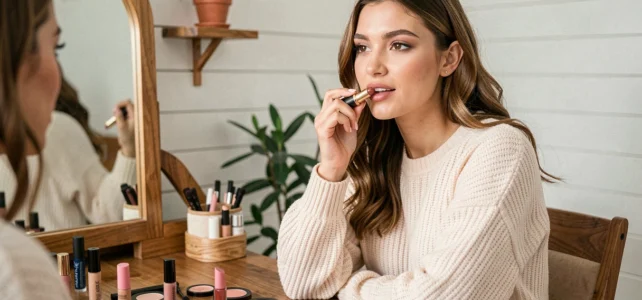
We’ve all had that three-euro foundation that turns into an orange mask after two hours, or that discounted mascara whose brush loses its bristles after the first use. Cheap makeup doesn’t have a good reputation, and part of this distrust is justified.
The beauty market in France actually declined in 2024 according to Kantar Media, with an annual drop of -5% in the makeup segment, prompting brands to rethink their discount ranges. The question is no longer whether you can wear makeup on a budget, but how to sort what is worth keeping from what ends up in the trash after a week.
Price per milliliter: the real calculation before buying cheap makeup
A lipstick priced at 2 euros seems unbeatable. Except when the tube contains barely 2 ml of product and you need to buy a new one every month. Several recent beauty guides emphasize the price per milliliter or gram as a reliable comparison criterion, much more telling than the face value price.
Specifically, you take the total price, divide it by the net content indicated on the packaging, and compare. An 8-euro foundation for 30 ml is cheaper than a 4-euro bottle for 10 ml. This simple reflex helps avoid impulsive purchases on clearance sites.
Stores like Nocibé are now structuring their offerings with permanent “Low Price” and “Good Deals” sections, showing that the discount segment is normalizing in beauty distribution. The same phenomenon can be seen among specialized online retailers. User feedback sharing their cheap makeup reviews beauty private confirms that some items under 5 euros compete with products three times more expensive, provided you check the actual weight.
Multifunctional beauty products: fewer tubes, less spending
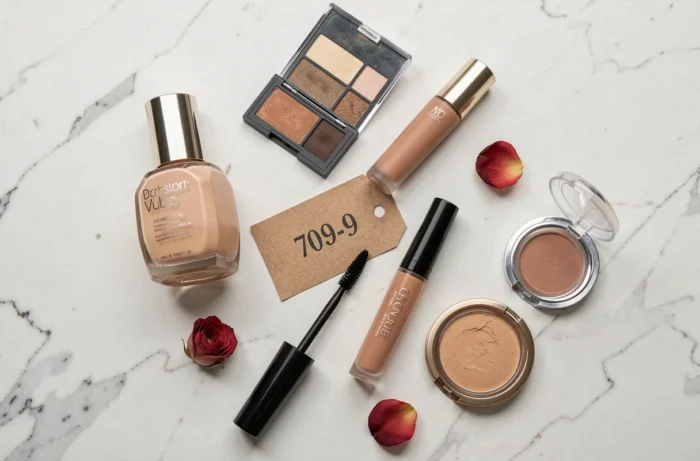
The most cost-effective strategy in cheap makeup isn’t always to look for the lowest price, but to reduce the number of products purchased. A cream stick that serves as both blush, eyeshadow, and lip tint replaces three distinct items.
This shift towards multifunctionality is not just a marketing argument. Beauty journalists regularly cite versatile products as the foundation of an economical and portable makeup kit. The idea is to buy based on actual need rather than the displayed discount.
Categories where versatility really works
- Tinted sticks and balms: a single product for cheeks, lips, and eyelids, with cream textures that blend with fingers without a brush
- Compact eyeshadow palettes: four to six shades are enough to cover daily and evening looks, provided complementary shades are chosen
- BB creams or CC creams: they combine moisturizing care, protection, and light coverage, avoiding the need to layer primer, foundation, and day cream
The trap is the “all-in-one” product that doesn’t do anything well. Feedback varies on this point, but a versatile product must excel in at least one use to be worth the investment.
Reliability of online reviews for discount makeup
When buying cheap makeup without being able to test it in-store, customer reviews become the main decision filter. The problem is that not all reviews are created equal.
Some distribution platforms now specify their moderation methods. Auchan, for example, indicates moderation by Bazaarvoice within 72 working hours. Sephora explicitly requests “objective” reviews focused on real experience. This transparency about review moderation is a reliability signal to check before trusting the ratings.
Criteria for spotting a useful review on a beauty product
- The review mentions skin type or usage context (oily skin, heat, wear over several hours)
- It compares the product to a known reference rather than simply saying “great” or “terrible”
- It specifies the duration of use before giving a verdict, as a mascara may seem perfect on the first day and flake after a week
- It is dated within the last year, as formulations change regularly in budget ranges
Cheap makeup and composition: what to check on the label
Low price does not automatically mean questionable composition, but it reduces the manufacturer’s margin for selecting ingredients. In very low-priced mascaras, eyeshadows, and lipsticks, some undesirable ingredients frequently appear in analyses.
Free tools allow you to scan the INCI list before purchase, directly from a smartphone.
Checking the INCI list takes thirty seconds and avoids unpleasant surprises, especially for products applied near the eyes or on the lips. Mucous contact areas (eyelids, mouth) are the most sensitive to irritants.
One last concrete point: discount ranges often reformulate their products without notice. A tested and approved foundation six months ago may have changed its composition during the next restock. Keeping the scanning reflex for each repurchase, even on a well-known product, remains the most reliable precaution when regularly buying cheap makeup.